I read the Guardian's interview with Susan Sarandon this morning, which leads with the provocative idea that if Hillary Clinton had won the election we'd be at war right now. My first reaction was "Fuck off", but I decided to skim the article and see what else she had to say. The Clinton stuff is pretty minor, but it got me thinking that the current wave of sexual harassment allegations and resignations would probably not be happening right now if we'd elected our first female president.
It's kind of an odd thing to think about, and I'm clearly not the only person thinking about it, since this article quoting Nancy Pelosi also showed up on the Guardian today. But it also reminded me of an article on fivethirtyeight.com where Nate Silver provided "dispatches" from the parallel universe where Clinton won the election.
That was before the Harvey Weinstein allegations came up, unleashing the flood that has taken down Kevin Spacey and Louis CK, and that's drawn attention on Al Franken and Roy Moore, so the biggest counterfactual Silver came up with (as I recall) was that the UK's election this past June would have strengthened Theresa May's Conservatives, rather than the diminished majority they got in reality.
But it's pretty clear that because Donald Trump's "locker room talk" on the infamous Access Hollywood tape didn't kill his presidency, we've been looking at this kind of behavior much more closely than we might have otherwise. After all, the women's marches back in January, on the weekend of the inauguration, were in response to his clear misogyny and lack of remorse over that and other actions he's taken that are pretty fucking gross.
Before any conspiracy theorists twist my words, it's clear that the accusations against Weinstein would probably have come out anyway, regardless of who was president, but it's fair to ask whether they would have taken on this life of their own and spread to other malefactors. Because the real issue around the accusations against Weinstein is that it touched off the #metoo thing, where many women felt they were able to share their stories. My Facebook and Twitter feeds were full of #metoo posts, both from people I know and shared from celebrities.
It's sort of cliche to say that Trump's election emboldened racists and whoever to come out into the open, but it's also true that as I walked on the treadmill at the gym that inauguration weekend I was next to two guys who were referring to the women's marchers as "rainbow dykes" and other pleasant names. It's hard to see them having that same conversation if the women's marches hadn't happened.
And that, in turn, is likely what led to a lot of women deciding they'd taken enough shit in their lives. After the Santa Barbara shootings, social media got divided between #notallmen (which is the #alllivesmatter of gender politics) and #yesallwomen, and unfortunately didn't take on the critical mass that #metoo is taking. Luckily, #metoo is phrased in such a way that assholes can't jump up and muddy the waters with semantics - there's no obvious response.
The other way is in the dominoes that have fallen since Trump took office. Clinton wouldn't have tapped Jeff Sessions for Attorney General, so his seat wouldn't have come up for election, and Roy Moore would just be this asshole known only to people in Alabama politics but few others. The accusations against him would still have come up, but if it were now, they wouldn't have the force they currently do, given that they dovetail with the wider #metoo movement; if he'd been up for the seat later, they'd probably have sunk because they didn't come on the tail of these others.
In either case, they wouldn't be the instructive example they are now, of a GOP that's so lost its way that it would rather have a safe vote for its agenda who's a pedophile. It's damaging not only because it makes a mockery of its standing as the party of traditional values (whatever that means), but also because they're clearly afraid of going out and selling their ideas. Their way or the highway.
So while this is a difficult time for all people of good conscience, there's a glimmer of a possibility that the big mistake our country made last November could make people more conscious of these issues. I won't say it'll definitely lead to a better environment for women, but we have the opportunity to improve things, and it's all because we're seeing how bad "bad" could get. Hopefully not too many people get hurt in other ways while we get back on the right track.
Sunday, 26 November 2017

Sunday, 19 November 2017
Self-policing social media
Just a quick PSA this week. We've been seeing Twitter taking a stand on accounts that broadcast hate, and/or that belong to neo-Nazis and other forms of racists (I don't like to use "white nationalist" because it obscures what these guys are actually preaching), and that's a long overdue step.
However, my PSA is a reminder that these things are self-policing, to a certain extent. I don't know about you, but when I first started using social media and playing online games, I'd see people being racist or homophobic, and I'd roll my eyes, wring my hands and wonder why the worst people congregate on the internet.
In one case, some brat on World of Warcraft thought the expression "sand niggers" was so hilarious that he (I'm assuming it was a he) copied and pasted it repeatedly on a group chat. I played on, without interacting with this person, and then mentioned it to my flatmate, who also played, in a what-can-you-do sort of way. And he just said, "Report it."
I haven't had much call to think about that exchange until recently (since 20 January 2017, to be precise), but it's stuck with me, and I've found myself taking that advice much more often. I'm also proud to say that almost all of the accounts I've reported have been found by Twitter to be in violation.
My reporting them probably didn't tip the balance either way, but it does feel like taking a stand, in a very low-stakes kind of way, for the type of online environment I'd like to see. It's not about stifling free speech, because I don't report people who are being jerks, and it's not about protecting myself from opposing viewpoints, because Nazis and white supremacists are not viewpoints that belong in the mainstream (mainly because why the fuck should you debate the merits of an ideology that wants to annihilate you?).
It's also a response to the nihilism of certain folks, usually young white guys, who like to make comments like this but then write them off as jokes. We can give the likes of PewDiePie the benefit of the doubt (but only the first time), but if they're just spouting racist and anti-Semitic comments to get laughs, we need to let them know it's not funny.
This is different from the Nazi-punching argument that erupted on the internet back in January when Richard Spencer getting punched turned into a meme. You might persuade yourself not to do anything by telling yourself that some racist is just going to report Black Lives Matter or something, but so what? If someone reports me for saying that I think the police shouldn't extrajudicially murder black people, Twitter's going to reject that report immediately, because that statement is not an incitement to race war or to go out and hurt anyone.
(BTW, I'm not only singling out white supremacists here. The reason my examples have all been related to Nazis is that in my day-to-day life I've never come across Islamist fundamentalist hate speech. I know it's out there, because I've heard ISIS/Daesh's Twitter game is on point, but for whatever reason I don't see it)
So take responsibility for the kind of online environment you want to see, just as surely as you should for real life. If someone started putting up swastikas in your town, you'd probably get the police to do something about it before Nazis overran the place. Nobody would expect you to take the law into your own hands, but whether on the street or on Twitter, it's up to people of good faith and honest ideals to work together to deny hate a place to flourish and attract more followers. And this isn't an abstract ideal, either: Heather Heyer was run over while protesting against neo-Nazis, while Jo Cox was shot and stabbed by someone who'd been indoctrinated by xenophobic hate.
So get reporting.
Sunday, 12 November 2017
A Quick Visit to Fort Worth
Gosh, so much to write about in the couple of weeks since my last post - do I talk about Stranger Things, or the increasingly surreal Senate race in Alabama? I'm going to opt for my rapid weekend in Fort Worth, since that's a little more fun.
I was there for a work event in Plano, which ended on a Friday, so I had the organizers fly me back on the following Sunday and I booked myself into a Best Western just outside Fort Worth. I spent it tooling around town, visiting museums and eating loads of unhealthy food, and if I didn't exactly get under the skin of Texas, it was at least fun to get to know that area a little bit.
The Best Western was a bit of a shock to the system after my hotel in Tokyo, and my hotel the previous night in Plano, being a smidgen more basic than either, but in the event was fine - the bed was comfortable, the drapes blocked out all light and even though there were a bunch of guests in town for NASCAR, I didn't have any trouble with noise.
Before I flew out a friend of a friend recommended Sundance Square, so that's where I spent my first evening, stuffing myself with barbecue and trying to decide on a place to drink. My first indication that I wasn't in California anymore was the Cigar Lounge, which looked pretty inviting, in a smoky, Eisenhower-Republican sort of way. But just to indicate the times we live in, that cigar place (where, in case it wasn't clear, you could smoke inside) was right next door to an artisanal olive oil shop. Go figure.
The following day, I opted for Fort Worth's Cultural District, a triangle of land right next to the University of North Texas, where there are about five museums, including some galleries for science and technology and for modern and contemporary art. I went first to the Kimbell Museum, which specializes in European art (with some galleries set aside for Asia, Latin America and Africa), and then to the Amon Carter Museum of American Art, which was just one enormous lawn over.
Both were pretty respectable - the Kimbell had some fine Renaissance and Dutch Masters, as well as nice Impressionist paintings, while the Carter made much of its Frederic Remington and Charles M Russell works, depicting scenes from the Old West like robberies and chases. At the Carter I took the opportunity to get a mini-guided tour by one of the docents, and as I happened to be the only taker I got the full experience, I'd say. Both are free, incidentally, which means you can spend more on food and drink.
Food-wise, I ate pretty damn well. Asked what my favorite food was that weekend, I had to say it was the chocolate pecan pie I ate at the Kimbell's cafe. It filled me up nicely after the soup and half sandwich, and was delightfully chocolatey (something I find important). And for dinner that night I had a pretty large platter of tacos, including the brisket tacos that are so popular in the area that even Dairy Queen sells them now (billed as street tacos).
To help make sense of it all I had Paul Theroux's latest travel book, Deep South, with me to read. In the early chapters, which are mostly in and around Alabama, he attends a gun show and a college football game, in between chatting with locals about their towns. I didn't quite get to either, though I saw a gun show advertised near my hotel, and I did visit Texas Christian University on Saturday afternoon, where I got to see how the locals in Fort Worth prepare for big games against rivals like the University of Texas.
Certainly the fairground atmosphere at TCU was light years away from my undergrad experience, where we didn't have a football team, but even if we'd had one, few people would have cared much. Here there were tents set up for sponsors' guest, like UBS, musical guests and a stand giving away free brisket tacos. Another stand sold signed memorabilia from TCU alumni who'd gone to play in the NFL.
Not everyone at TCU was a student, or parent of a student, but it was clearly the big social event, with a lot of the women all dolled up as if they were going out on the town. I don't get out to Stanford games much, but I have trouble seeing it as more than an afternoon out for people in my town, though in fairness I should probably go investigate (seems Stanford's playing Cal soon, so might check that out...).
I guess what's interesting, if not exactly original, is that sense of being in a different place, even if it is still America. Here in Palo Alto, if you ran around wearing a cowboy hat or cowboy boots, people would think you a little strange, but it's part of the culture there. Beyond superficial stuff like that, there is a sense of different rhythms, and of people enjoying different rituals than they do here - even of enjoying rituals at all, which I find hard to recall from growing up in Palo Alto.
It would have been nice to spend a little more time there, and potentially meet up with a college friend who lives there now, to get a local's sense of what Fort Worth is like. But I can at least say that in these days of political polarization and regional estrangement, it was good to spend some time out of my bubble and seeing some of what we have in common, instead of where we disagree.
Plus, I got to spend the weekend zooming around in this bitchin' ride:
 |
| Upgraded from a compact, FYI |
Sunday, 29 October 2017
Tokyo 2017: Lost in Franslation
Yeah, I'm back from Japan, and yeah, I went with that title. I couldn't help it - the movie and its soundtrack kind of informed large parts of the time I spent there, since I listened to the music as I rode in on the bus from Narita Airport and since I went to the hotel where the movie was set. There's obviously more to the city than Lost in Translation, but it made for a nice backbone to the trip for me.
First things first: Tokyo's amazing, and you really need to go. It's big and sprawling, but orderly, clean and well-run. There's shopping, museums, sights to see and amazing places to eat. I feel like I could have spent way more time there, even just walking around the city - and if I'd had even more time I'd like to have gone out more into the rest of the country.
This is, of course, despite the fact that Tokyo was being hit by a typhoon and the fact that the government was holding an election. While I noticed the typhoon, because I was out at the Tokyo National Museum that day, the election completely passed me by until I saw mentions of it on social media the next morning.
That kind of leads into one of the points I made in my last post, about language. I was warned ahead of time that English-speakers aren't very common, and while this turned out to be true, it also proved to be unimportant. Almost everything important was signposted in English, especially on the Metro, and the unlimited 2G data on my roaming plan meant that in a pinch I could just use a maps app to get around. This turned out to be helpful for getting around on foot between spots that were closer together than they seemed on the transport maps.
I also determined that I had just about enough Japanese to accomplish the fairly limited range of things I needed to do. Restaurants, museums, stores - all of it was completely navigable, and I found the people working in customer service to be very patient. Heck, there were even some normal folks on the train back from Kamakura who were either able to speak a little English or give easy answers to my basic questions. It's probably different if you go to the real countryside, but for where I spent my time, I got on perfectly well.
The locals seemed to be pretty patient in general - a refrain I kept telling myself was that to them I'm kind of a barbarian, and so barbaric behavior is expected of me. This ranged from taking pictures of everything, to asking confusing things in restaurants, to not knowing the proper greeting when entering a store or restaurant.
In terms of activities, I feel like I struck a good balance between seeing museums and exploring neighborhoods. My first full day there I walked from my hotel in Akasaka to Roppongi, which is nearby, and caught a couple of art museums and a couple of malls. The second day, when the typhoon hit, I was at Ueno Park for the National Museum, and the rest of the time I was hopping around between neighborhoods on the Metro, including checking out the nightlife in Shinjuku and Shibuya (the site of the famous crossing with all the big animated advertising).
I even managed to check out a couple of residential neighborhoods, places that looked quintessentially Asian to me - narrow streets that from the outside looked like alleys but happened to be where all the residential buildings were. When I went to Kamakura on the Tuesday, I determined that this layout was common to both big cities and smaller towns.
The other notable thing about the built environment was much green space there was, and how much you could find if you just turned down a street. In the park next to the Canadian Embassy (which has a rock garden that my guidebook highly recommended), you could see little shrines dotted around among the trees. Others could be found on random corners in Tsukiji, near the fish market, and in Roppongi, just off the main drag as I walked back to my hotel that first day.
I was also lucky enough to have a friend of a friend who I was able to meet in town my first night, when I'd just got off the plane. She introduced me to a couple of friends of hers, who took me first to an Italian restaurant (done Japanese style, though) and then to a little hole-in-the-wall sake joint where the sign outside and the menus inside were all in Japanese only. Certainly you could eat perfectly well if you stick with places that have Western signage, but if you know someone there, have them take you to someplace local; failing that, you can use startups like Vayable (which is actually founded by a former classmate of mine, though I haven't used it myself) to get someone to show you around. In places where you can't read the language, and are in fact as helpless as a child, that's a fun way to visit places you'd miss otherwise.
If there was a negative, it's that the bookstores didn't have much in the way of English books. It's kind of a shame, because there were loads of bookstores everywhere I went, but at the same time, most of what I did find in English was stuff I could get back home. On the other hand, it was nice to see how many bookstores there were, all dotted around the city. Contrast that with Singapore or Hong Kong, where most of the bookstores were pretty terrible.
So Tokyo comes highly recommended. There's loads to see, do and eat, and it's easy to get around. Once you figure out certain things, like which side of the escalator is for standing, or how to determine which platform your subway train leaves from, it's pretty easy to navigate. And if you turn even minimally adventurous, for example by walking down the narrow alleys of Tsukiji Fish Market or dropping into the cat cafe in Akihabara, you can have some amazing, unique experiences.
Go check it out. Now!
 |
| View from the hotel in Lost in Translation |
First things first: Tokyo's amazing, and you really need to go. It's big and sprawling, but orderly, clean and well-run. There's shopping, museums, sights to see and amazing places to eat. I feel like I could have spent way more time there, even just walking around the city - and if I'd had even more time I'd like to have gone out more into the rest of the country.
This is, of course, despite the fact that Tokyo was being hit by a typhoon and the fact that the government was holding an election. While I noticed the typhoon, because I was out at the Tokyo National Museum that day, the election completely passed me by until I saw mentions of it on social media the next morning.
That kind of leads into one of the points I made in my last post, about language. I was warned ahead of time that English-speakers aren't very common, and while this turned out to be true, it also proved to be unimportant. Almost everything important was signposted in English, especially on the Metro, and the unlimited 2G data on my roaming plan meant that in a pinch I could just use a maps app to get around. This turned out to be helpful for getting around on foot between spots that were closer together than they seemed on the transport maps.
I also determined that I had just about enough Japanese to accomplish the fairly limited range of things I needed to do. Restaurants, museums, stores - all of it was completely navigable, and I found the people working in customer service to be very patient. Heck, there were even some normal folks on the train back from Kamakura who were either able to speak a little English or give easy answers to my basic questions. It's probably different if you go to the real countryside, but for where I spent my time, I got on perfectly well.
The locals seemed to be pretty patient in general - a refrain I kept telling myself was that to them I'm kind of a barbarian, and so barbaric behavior is expected of me. This ranged from taking pictures of everything, to asking confusing things in restaurants, to not knowing the proper greeting when entering a store or restaurant.
In terms of activities, I feel like I struck a good balance between seeing museums and exploring neighborhoods. My first full day there I walked from my hotel in Akasaka to Roppongi, which is nearby, and caught a couple of art museums and a couple of malls. The second day, when the typhoon hit, I was at Ueno Park for the National Museum, and the rest of the time I was hopping around between neighborhoods on the Metro, including checking out the nightlife in Shinjuku and Shibuya (the site of the famous crossing with all the big animated advertising).
I even managed to check out a couple of residential neighborhoods, places that looked quintessentially Asian to me - narrow streets that from the outside looked like alleys but happened to be where all the residential buildings were. When I went to Kamakura on the Tuesday, I determined that this layout was common to both big cities and smaller towns.
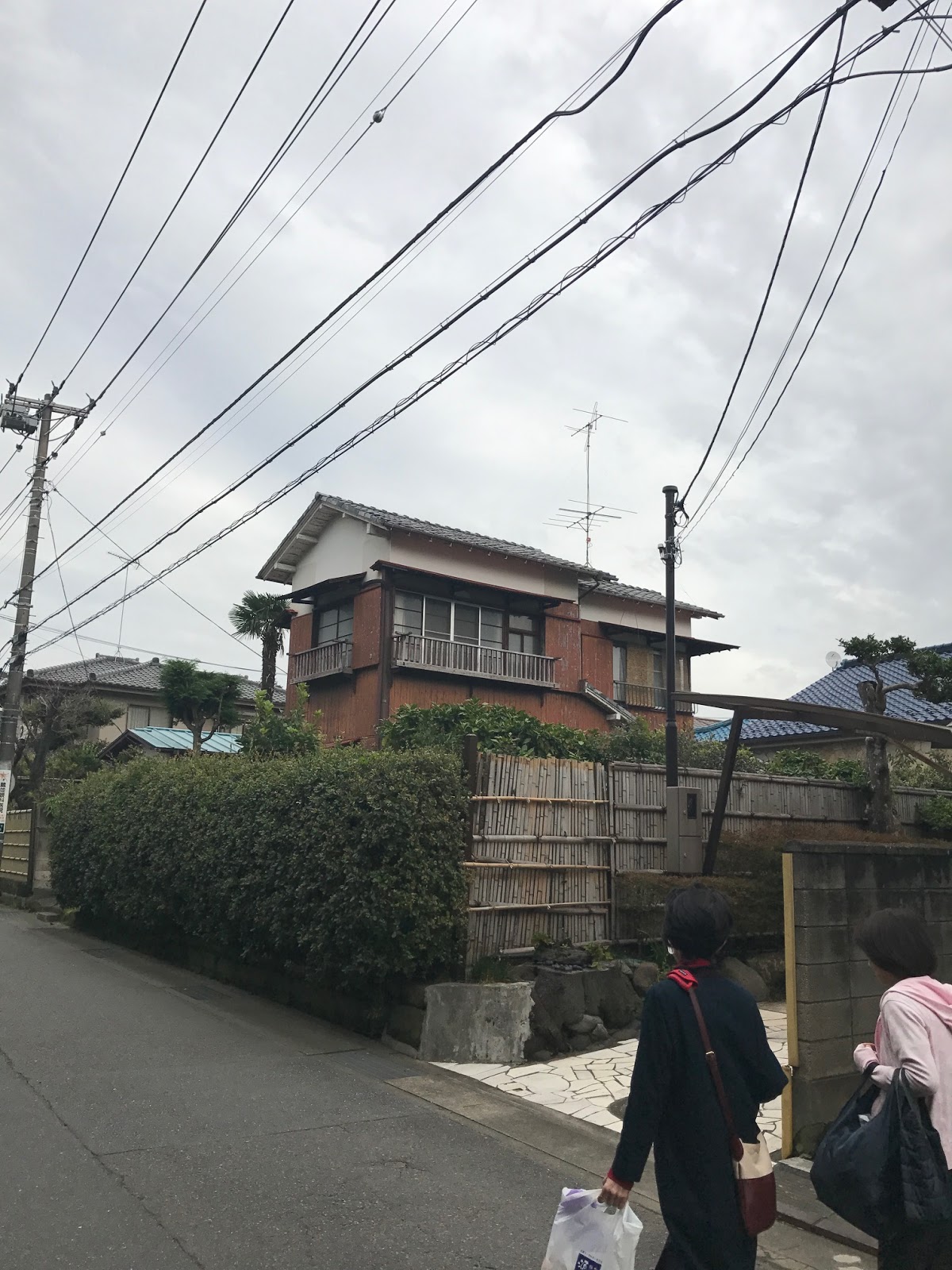 |
| Kamakura |
The other notable thing about the built environment was much green space there was, and how much you could find if you just turned down a street. In the park next to the Canadian Embassy (which has a rock garden that my guidebook highly recommended), you could see little shrines dotted around among the trees. Others could be found on random corners in Tsukiji, near the fish market, and in Roppongi, just off the main drag as I walked back to my hotel that first day.
I was also lucky enough to have a friend of a friend who I was able to meet in town my first night, when I'd just got off the plane. She introduced me to a couple of friends of hers, who took me first to an Italian restaurant (done Japanese style, though) and then to a little hole-in-the-wall sake joint where the sign outside and the menus inside were all in Japanese only. Certainly you could eat perfectly well if you stick with places that have Western signage, but if you know someone there, have them take you to someplace local; failing that, you can use startups like Vayable (which is actually founded by a former classmate of mine, though I haven't used it myself) to get someone to show you around. In places where you can't read the language, and are in fact as helpless as a child, that's a fun way to visit places you'd miss otherwise.
 |
| Spotted at Tsukiji Fish Market |
If there was a negative, it's that the bookstores didn't have much in the way of English books. It's kind of a shame, because there were loads of bookstores everywhere I went, but at the same time, most of what I did find in English was stuff I could get back home. On the other hand, it was nice to see how many bookstores there were, all dotted around the city. Contrast that with Singapore or Hong Kong, where most of the bookstores were pretty terrible.
So Tokyo comes highly recommended. There's loads to see, do and eat, and it's easy to get around. Once you figure out certain things, like which side of the escalator is for standing, or how to determine which platform your subway train leaves from, it's pretty easy to navigate. And if you turn even minimally adventurous, for example by walking down the narrow alleys of Tsukiji Fish Market or dropping into the cat cafe in Akihabara, you can have some amazing, unique experiences.
 |
| Yep, this happened |
Go check it out. Now!
Sunday, 15 October 2017
Some Business Before Going to Tokyo
On Thursday I'm heading out to Japan for a week, because I haven't been before and I really wanted to spend a couple of thousand that I don't have on a nice vacation. I've been eyeing it up as a destination for my big solo trip this year, reasoning that now's as good a time as any to do, well, anything. And if the geopolitical situation is anything to go by, this might be the last chance any of us gets.
I'm kidding, of course! But it's hard not to think about that, and all the missiles that might be flying overhead at any given time. I console myself with the fact that my stated goal is to see the world or die tryin', and if anything weird happens, well, I'll have met that goal.
On a more positive note, I've been preparing by watching some of my favorite movies set in Japan, namely Kill Bill Part 1 and Lost in Translation (which I watched last night, as I write this). Not sure how accurate the picture provided by either film is, but in any case it was fun rewatching them close together - coincidentally that's also how I recall watching them the first time, in London, with my mom, and in the exact same theater in Leicester Square. I can't think of two directors less similar than Quentin Tarantino and Sofia Coppola, but those two movies, at least, will always be indelibly linked in my brain.
The movie I haven't watched to get myself ready is, oddly enough, The Fast and The Furious: Tokyo Drift. Not because I don't want to, but I've already had toxic levels of exposure to the damn thing and I'll just be disappointed when I don't locate the city's underground multilevel car park racing scene. I've been thinking of downloading the Lost in Translation soundtrack, but as I write these words I should probably do the same for Tokyo Drift.
I also spent some time messing around with Japanese on Mango Languages, but it hasn't stuck and frankly I'm kind of relishing the opportunity to get around with my limited Japanese and inability to understand any answers I'm likely to get. Or if not relishing, then intrigued to see how I get on. Loads of people do it, right? It'll be good practice if I ever lose the ability to read because of brain damage caused by watching too much Tokyo Drift (even if I consider that a contradiction in terms).
In any case, I've got my guidebook and am collecting ideas on what to do for a day trip outside the city. Current front runner is Kamakura, labeled as Tokyo's Kyoto, because I won't be able to get to the real Kyoto. I'm also looking up ideas for museums and restaurants in the city, and whether I can find a good English section at Kinokuniya bookstore - I keep having to remind myself that the one in Singapore had an amazing English section because everyone there speaks English, and the situation is slightly different in Tokyo.
Obviously I'll also have my phone and iPad with me, so I'm hoping to lard the next post with a crapload of pictures. And the best thing is, I've got an Airbnb guest staying while I'm away, so my damn house will make me some cash while I'm away! The money will come in handy when I'm deciding which life-size Gundam model to bring home.
In any case, this scattershot blog post should show how damn excited I am to be going. I feel like my earliest exposure to Japanese culture (Teenage Mutant Ninja Turtles) and every video game and anime and manga and Takeshi Kitano film I've consumed since then is leading to this trip. And I'm really hoping to get out to the Park Hyatt Tokyo, where Lost in Translation takes place - then I'll know I'm in Tokyo...
Sunday, 8 October 2017
Catching Up With Blade Runner
With all the hoopla over Blade Runner 2049, I thought it would be a good time to check out the original. I'd been seeing discussions and reviews and thinkpieces for a while, and I think what tipped me over the edge was a discussion on The Verge about which version is best. I'm not going to wade into that argument, but I will say the article made me decide to rent the original, theatrical cut, instead of the Final Cut that Ridley Scott released in 2007 (and which stands as the only time I've seen that movie in the theater).
What's odd is that I actually remembered very little. I could still recall the broad strokes of the plot - the replicants coming to earth to confront their creator, Deckard being sent after them - and some of the smaller moments, like when Deckard retires Zhora, the stripper replicant, or Roy Batty's demise as he tells Deckard of the things he's seen. But I didn't remember the connecting glue, how we got from one plot point to the next.
This might be down to the length of time since I'd last seen the movie (i.e. that Final Cut in 2007), as well as the fact that there are so many versions floating around, with different scenes and editing, that it's hard to keep track of much more than the big stuff. However, I also think it's related to where I was in life when I first watched the movie, vs where I am now.
As a 15 year old (or whatever age I was when I first saw it; might have been earlier, come to think of it), it was hard to see beyond the surface of the plot, and beyond the aesthetics. Deckard drinking alone in his apartment is an image that's stuck with me for decades, for example.
But this time it was easier to see the movie from the perspective of Roy Batty and the other replicants. Batty's line at the end, where he asks Deckard how it feels to live in constant fear and compares it to slavery, landed much more squarely for me this time. It's also easier to appreciate Rutger Hauer's performance as a man struggling for every last moment as the end of his life approaches - where I would have seen the menace and little else, now I can see him as the hero of his own story, in which Deckard is the villain (although the bit where Batty crushes his creator's head is pretty villainous).
It also helps that I'm considering these points both in my own life (not imminently, thank fuck, unless something happens with North Korea) and in my fiction, where I've just written my hacky robot short story. Consciousness and existence, and cogito ergo sum, and all that.
More than anything, though, I'm reminded of what a weird, singular film it is. Amazon helpfully tallies up all of the main crew and cast on the Fire TV, and shows you other movies they've worked on, so you can buy or rent those, too; of Ridley Scott's body of work I count ten movies that I've seen. They're maybe not as highly stylized as some other directors' work, like the Coen Brothers or Wes Anderson, so it's hard to draw a connecting line between Alien, Blade Runner and Gladiator (to choose several at random).
In a lot of ways it has more in common, thematically and visually, with Alien Covenant, which also plays with questions about the nature of life and intelligence, while building on weird design and art for its settings. But I don't know if I'd be able to connect them to the same director, and certainly not to Gladiator or A Good Year.
That's probably the Philip K Dick influence, though even that is relatively faint, when I think back to what little I remember of Do Androids Dream of Electric Sheep. Still, it's a very weird, brooding type of film, especially if you contrast it with Harrison Ford's other big roles at that time; that, and the surfeit of edits and director's cuts is probably what's made Blade Runner such a rich trove of discussion on What It All Means.
I can't pretend to have the answer, but it was interesting to watch it this time with the knowledge in mind that Deckard himself may be a replicant. Ridley Scott has certainly implied as much, and it sounds like there's some resolution, or discussion, of this point in the new sequel.
Still, the reviews make me cautiously optimistic, as does the fact that it's helmed by Denis Villeneuve, who seems to revel in weirdness and symbolism. He, after all, also directed Arrival, which has a similar dream-like quality to it in which you never know exactly what's happening.
If nothing else, by watching the original Blade Runner, I'm up to speed and can go and enjoy the new one. Here's hoping that one also has people debating it fiercely for the next thirty years.
Sunday, 1 October 2017
Top of the Funnel, or Why We Aren't Successful
As I'm fond of noting, I've spent a lot of time over the last few years consuming self-help and productivity books, blogs, podcasts, what-have-you. For the most part I think I've been lucky, because most of it has been transferable to my own life, even if I still have trouble with the concept of not checking my email first thing in the morning.
But I think that we, or at least I, sometimes lose sight of what we're trying to accomplish when we adopt life hacks and come up with really complicated ways to accomplish things. And then we, or at least I, get pretty frustrated at the perceived lack of progress in our chosen areas, which means either giving up the self-help stuff or getting more of it.
Still, the most insightful thing I heard on this topic was on Tim Ferriss's podcast, where some internet entrepreneur (I'm too lazy to go look it up) mentioned the concept of "top of the funnel". Someone out there is probably shaking their head right now at how basic this is, but bear with me, because everyone who's not where they want to be is doing this.
The example in the Ferriss show was getting a new router, to make sure you're downloading the internet at the most optimal speed - everything else you do, from buying Wi-Fi range extenders to upgrading your laptop or whatever, can deliver only incremental gains but replacing your router (ie improving the process at the top of the funnel) means those improvements can deliver even better value.
It's not a 100% match to what I'm thinking of, but at heart it's an illustration that if you want to fix something, you have to get the basics right. If your internet is slow, then the basic thing is to get a new router (I'm not saying to get a new ISP because if you're in America you don't have any choice).
Here are some examples from my own life:
The financial basis of the internet, according to another Tim Ferriss guest (I think it was Ramit Sethi this time, but again - too lazy to go check) is to help people get rich, get skinny or have sex. That's besides porn, of course. But nobody would buy any of it (except for porn) if the advice consisted exclusively of "Get a well-paying job and don't spend money stupidly; eat more fruits and vegetables and move around once in a while; and be a nice person who has lots of friends."
I'm aware that this may seem to contradict previous posts I've written where I talk about doing less and not being too tough on yourself. This post is also borne of my own frustration at not accomplishing as much as I think I "should" have. But it doesn't contradict those earlier posts, in truth, and it carries a hopeful message, which I'm going to share with you now.
Being in good shape may seem unattainable, but it's not an arcane thing - all you have to do is eat better and move more. Meeting romantic partners is only possible if you make some effort to go out and meet them, whether by getting shot down in bars or by swiping all night on Tinder. And having money is as simple as getting a job that pays you enough to live off, and not spending so much that you can't support yourself.
You may say there are external factors stopping you in one or more of these cases, and for individual people there may well be. But the hopeful bit is that it's in your control, at least to a certain extent.
One of my favorite parts of Brian Tracy's book, Goals, is when he refers to Barry Sears's Zone Diet, and specifically where he notes that falling off the wagon and eating something not Zone-approved isn't the end of the world. Instead, he says, getting back into the Zone is as easy as eating another Zone meal.
For our purposes today, getting back on track is as simple as taking the actions needed to get back on track. You don't have to build it up into anything more complicated than that. And once you have the top of the funnel sorted out, then you can start making the incremental changes to see even more success.
But I think that we, or at least I, sometimes lose sight of what we're trying to accomplish when we adopt life hacks and come up with really complicated ways to accomplish things. And then we, or at least I, get pretty frustrated at the perceived lack of progress in our chosen areas, which means either giving up the self-help stuff or getting more of it.
Still, the most insightful thing I heard on this topic was on Tim Ferriss's podcast, where some internet entrepreneur (I'm too lazy to go look it up) mentioned the concept of "top of the funnel". Someone out there is probably shaking their head right now at how basic this is, but bear with me, because everyone who's not where they want to be is doing this.
The example in the Ferriss show was getting a new router, to make sure you're downloading the internet at the most optimal speed - everything else you do, from buying Wi-Fi range extenders to upgrading your laptop or whatever, can deliver only incremental gains but replacing your router (ie improving the process at the top of the funnel) means those improvements can deliver even better value.
It's not a 100% match to what I'm thinking of, but at heart it's an illustration that if you want to fix something, you have to get the basics right. If your internet is slow, then the basic thing is to get a new router (I'm not saying to get a new ISP because if you're in America you don't have any choice).
Here are some examples from my own life:
- So why am I single? Because I don't know enough single women. And because on a Sunday evening I'm writing this blog rather than meeting more single women (though in fairness I was out and about in downtown Palo Alto last night).
- Why am I not the shredded Adonis that I think chicks would dig? Because I eat quite a lot of crap and sit at desks all the time, either working or writing this blog.
- Why haven't I sold the proverbial good fantasy novel? Because I don't write enough and I don't submit enough. Simple as that. And when I say write, I also mean edit, revise, fine-tune, etc.
- Why am I broke? Because I spend too much money on frivolous things and because I work at a job that doesn't pay well.
The financial basis of the internet, according to another Tim Ferriss guest (I think it was Ramit Sethi this time, but again - too lazy to go check) is to help people get rich, get skinny or have sex. That's besides porn, of course. But nobody would buy any of it (except for porn) if the advice consisted exclusively of "Get a well-paying job and don't spend money stupidly; eat more fruits and vegetables and move around once in a while; and be a nice person who has lots of friends."
I'm aware that this may seem to contradict previous posts I've written where I talk about doing less and not being too tough on yourself. This post is also borne of my own frustration at not accomplishing as much as I think I "should" have. But it doesn't contradict those earlier posts, in truth, and it carries a hopeful message, which I'm going to share with you now.
Being in good shape may seem unattainable, but it's not an arcane thing - all you have to do is eat better and move more. Meeting romantic partners is only possible if you make some effort to go out and meet them, whether by getting shot down in bars or by swiping all night on Tinder. And having money is as simple as getting a job that pays you enough to live off, and not spending so much that you can't support yourself.
You may say there are external factors stopping you in one or more of these cases, and for individual people there may well be. But the hopeful bit is that it's in your control, at least to a certain extent.
One of my favorite parts of Brian Tracy's book, Goals, is when he refers to Barry Sears's Zone Diet, and specifically where he notes that falling off the wagon and eating something not Zone-approved isn't the end of the world. Instead, he says, getting back into the Zone is as easy as eating another Zone meal.
For our purposes today, getting back on track is as simple as taking the actions needed to get back on track. You don't have to build it up into anything more complicated than that. And once you have the top of the funnel sorted out, then you can start making the incremental changes to see even more success.
Subscribe to:
Posts (Atom)