I'm not saying anything radical when I suggest that the American mindset seems to be "more = better". This is why we've gotten so fat and unhealthy, why we keep buying too much crap that we don't need, and, maybe, why we spend too much time at work or at school.
Now, to put things into perspective, I'm told that in Asia they work even harder than Americans do, so we'll have to put this all into perspective for a moment, and try not to fall into cultural selection bias traps. But the principle remains the same - we have this idea that time spent at our desks means we're working hard.
You could suggest I've been reading too much Tim Ferriss lately, and you'd be right, but that doesn't invalidate the point. A Bank of America intern recently worked himself to death here in London, which has prompted a lot of hand-wringing about "presentee culture" and requirements for interns, but it seems like something that'll blow over soon and the financial industry will be back to business as usual (no pun intended).
The reason for that, of course, comes down to game theory and the prisoner's dilemma: no matter how many programs Bank of America puts in place to send people home at a reasonable hour, there'll always be some grasping asshole who reasons that staying at his desk an extra hour will get him favorable reviews from his bosses, and some asshole supervisor who'll reward him for it.
Don't get me wrong, I understand when you actually work in a high-pressure environment there's sometimes the need to stay at work late and get things done. But this becomes an arms race where even people in regular jobs get coerced somehow into putting in late hours, even if all they end up doing is playing solitaire or updating their Facebook profile. This isn't just a money-saving or productivity issue, though - it becomes a health issue when the company's presentee culture leads to stress-related illnesses and burnout.
I've been reading about this stuff in an e-book I picked up recently, called Brain Rules. It's by a developmental molecular biologist called John Medina, and among his chapters he talks about how stress affects the brain and learning. He makes a couple of good points about getting more efficiency out of employees by moving away from the straight-jacket schedule of 9-5 (or, for financial folks, 7am-10pm), and helping them manage stress at home to avoid burning out at work.
One of the points where I think it falls down, though, is when it comes to education. He suggests a different repetition-based model, where a concept is introduced at the beginning of the school day and repeated at different points throughout the day (this is a gross simplification). So far, so good. But then he suggests that this means the school year should be lengthened.
To be honest, we're already lengthening it, and I don't believe that's a good idea. As part of President Obama's Race to the Top program in education, not only are we effectively doubling down on teaching to standardized tests (another delightful holdover from President Bush), but we're also starting the school year earlier, ending it later and keeping students behind desks for more time.
There's apparently good research behind this, explaining that the longer kids stay out of school over the summer, the more they forget what they learned the previous year. But given that we stubbornly remain at the bottom of the rankings for math, science and whatever, compared to other industrialized nations, I don't know if this solution of increasing the workload and the time commitment is really the answer.
So it seems to me like Dr Medina's suggestion is to do away with even more summer time, to make learning more efficient. I can't argue with him on scientific grounds, but surely we could do what they do in Europe instead, and assign kids homework to do over the summer? This is, naturally, something I would have rebelled against when I was in school (and to be honest the idea is still pretty unappealing), but it seems a lot less onerous than forcing kids to sit in school for even more of their lives.
Because it comes down to a cultural issue, too - free time is when we're free to be who we really are, or want to be. This is why I believe that employees need to have more vacation time, and more time outside of work in the evenings. I'm lucky enough to work someplace where they don't mind that I leave every night at 5.30 on the dot, because they see that I get my work done - but I think a lot of my colleagues could do with organizing themselves better, so that they don't have to stay late either.
Unless they want to, of course. To each their own.
Sunday, 29 September 2013

Saturday, 21 September 2013
Frad Lab World Tour Continues: Close to the Natural World in Queensland
So the other spot that I've been feeling a bit nostalgic for from last year's trip is, of course, Cairns, which was the third leg of my trip. Where the previous two legs had been essentially city breaks, now I was heading into less built-up areas, and most of my activities would revolve around the amazing array of natural landscapes they have up in Far North Queensland.
Landing was the first shock, because I'd just flown for three hours from Sydney, over a gigantic expanse of brown, but as we came in to Cairns Airport, everything turned green, hilly and lush. And when I say everything, I really mean everything - it wasn't clear there was an airfield until we were pretty much there. It might as well have been Jurassic Park.

I don't use that comparison lightly, by the way. The original movie was filmed in Hawaii, on the island of Kauai, where for a few summers we took our family vacations instead of going to Italy. Even though those trips were about twenty years ago, I remember a lot of Kauai clearly, and was struck several times by how similar Cairns and its environs were to it.

I was there to stay with my friend Kyle and his family, as after several years of listening to his stories about the place I'd decided it was time to go see it for myself. Their house was a bit north of Cairns proper, in a woody area called Clifton Beach, and was just a ten minute walk from the beach. The house itself was lovely, rambling and spacious, with fruit trees in the back yard and wild birds of all kinds hanging out every night. Kyle's mom lives there, and his brother Lee (whom I knew from our trip to Phuket a couple years earlier) also spent a few nights there each week. But in addition, Kyle's other two brothers, Hew and Simon, had come up to stay for a week or two, so it was a pretty full house.
In a lot of ways, the Queensland part of the trip was a look at Australia's range of diversity, much more than Sydney. Kyle took me out to see Kuranda, in the Atherton Tablelands, the rainforests of the Daintree National Park, the Great Barrier Reef, and we even went for a road trip south to Mackay, to visit his best friend Glenn (who I also knew from Phuket). That drive down to Mackay gave me a glimpse of what a lot of people must imagine when they think of Australia - flat, dusty, scrublands enlivened by the occasional town or gum tree. It actually reminded me in some ways of driving from San Francisco to Los Angeles via the Central Valley, although I'll admit we have a little less kangaroo roadkill on the I-5.
Roadkill aside, there was a lot of nature on show in that corner of Queensland. The first full day I was there, we drove up to Kuranda to see the town and the jungle surrounding it. There was a zoo of venomous animals, which pretty well satisfied my curiosity about Australia's fauna in all its toothy diversity. In the main hall were glass cases for the snakes and spiders, each containing dire warnings not to lean on or over the cases, and upstairs, by the entrance, the zoo's employees were giving lectures on the various types of spiders, centipedes and lizards they kept up here.

They even brought a couple out and let us pet or hold the lizard, which wasn't actually poisonous; I chose not to be disappointed by that. Interestingly, they also said how the centipede they had here on show had venom that the Aborigines had used traditionally for its anti-inflammatory properties. Hearing that certainly put my previous discomfort around spiders in London in perspective; this state of affairs that lasted for just a few weeks, when, back home, I opened a packet of salad, drenched it in dressing and promptly found a not particularly pleased looking spider in among the leaves.
Coming down from Kuranda was the most spectacular part, though, because you can get back down to the area around Cairns via cable car (there's also a train that goes up and down the mountain, so I'll have to give that a try next time). I caught it pretty much at the end of the day, so I didn't dawdle too much at each stop, where they let you out to have a look at various displays of local plants and animals. But traveling over the treetops was spectacular, and when it began its descent, after the third stop, I got an amazing view of the entire plain heading out to the sea. Touristy as Kuranda itself is, no one should miss out on the Skyrail.


The next day was Daintree, which involved a pretty long drive through increasingly jungly terrain. We even crossed the Daintree River on a cable ferry, which is the only way up to Cape Tribulation (so named because Captain Cook had a pretty terrible time there) by road. Kyle, with the jaunty confidence of so many Australians when talking about their native animals, informed me that the Daintree River was absolutely chock-full of crocodiles, so I naturally spent the five-minute crossing with my face pressed to the window for a glimpse, but ended up disappointed.
In fact, every body of water we passed during that week held them, according to him, but I never saw a single one. To compound my disappointment, the day before at Kuranda, we'd stopped for lunch at a German-style sausage place, which advertised exotic meats like crocodile or kangaroo. I duly ordered up a croc sausage, but was balked when they told me it'd take twenty minutes to prepare. I presumed this meant they had to go out and catch one, slaughter it and prepare it, so I forebore, not wanting to put the owners in any further danger, but it's disappointing I didn't get to reassert to the crocodiles of Queensland just who's at the top of the food chain.
By the way, lest you think all Australians are like Crocodile Dundee when it comes to their deadly animals, I was interested to hear that one of the snakes on display at the Venom Zoo had once made its way into Kyle's living room.
"What did you guys do?" I asked, expecting some frontier story about getting a long stick and extracting the snake that way.
"We called animal services and stayed the hell out of there until it was gone," he said, which is kind of reassuring, if you think about it. It typically means pranks won't involve you finding, say, a bird-eating spider in your sheets at the end of the day.
Anyway, the Daintree was impressive too, just as much as Kuranda. For one thing, according to Bill Bryson, a lot of it is pretty much unchanged from the times of the dinosaurs. We didn't see any T-rexes, which is probably for the best, but we did see something even less common (as it were): the cassowary, a large, blue flightless bird that only lives in the forests of Queensland. Not only that, we saw two of them! Even Kyle and his brothers were impressed, because cassowaries are very shy and retiring. This made up for the lack of crocs. And frankly, cassowaries are a little less interested in sampling how you taste, so this is fine with me.

This is running a little long, so I'll have to gloss over the Great Barrier Reef, except to say that I gave scuba diving a try and found it amazing down there. Even if you only ever snorkel, though, a visit to Far North Queensland should include taking a boat out to the reef, because its diversity is stunning.
The point, though, is that for all the tourism and backpacking that comes to Cairns, and frankly renders parts of it not particularly charming (Kyle told me of a nightclub called Troppo's, which locals had re-christened Sloppo's), it struck me as a part of the world where the man-made and natural worlds live even closer together than in most other places. It's a good thing to keep in mind, because it means the locals are duly wary but not freaked out by having so many dangerous animals around all the time. For instance, I'd timed my visit to avoid the start of stinger season, when box jellyfish make Queensland's waters unapproachable; during stinger season, therefore, Queenslanders simply go to the pool.
I read another blog post once by a woman from Cairns, who said it was a place that wasn't really designed for humans to live in. I disagree - as long as you stay alert and don't do anything stupid, it's a very hospitable place indeed.
Just don't forget about the hurricanes, and don't eat the chiko-rolls.
Landing was the first shock, because I'd just flown for three hours from Sydney, over a gigantic expanse of brown, but as we came in to Cairns Airport, everything turned green, hilly and lush. And when I say everything, I really mean everything - it wasn't clear there was an airfield until we were pretty much there. It might as well have been Jurassic Park.

Far North Queensland
I don't use that comparison lightly, by the way. The original movie was filmed in Hawaii, on the island of Kauai, where for a few summers we took our family vacations instead of going to Italy. Even though those trips were about twenty years ago, I remember a lot of Kauai clearly, and was struck several times by how similar Cairns and its environs were to it.

Seafront Cairns
I was there to stay with my friend Kyle and his family, as after several years of listening to his stories about the place I'd decided it was time to go see it for myself. Their house was a bit north of Cairns proper, in a woody area called Clifton Beach, and was just a ten minute walk from the beach. The house itself was lovely, rambling and spacious, with fruit trees in the back yard and wild birds of all kinds hanging out every night. Kyle's mom lives there, and his brother Lee (whom I knew from our trip to Phuket a couple years earlier) also spent a few nights there each week. But in addition, Kyle's other two brothers, Hew and Simon, had come up to stay for a week or two, so it was a pretty full house.
In a lot of ways, the Queensland part of the trip was a look at Australia's range of diversity, much more than Sydney. Kyle took me out to see Kuranda, in the Atherton Tablelands, the rainforests of the Daintree National Park, the Great Barrier Reef, and we even went for a road trip south to Mackay, to visit his best friend Glenn (who I also knew from Phuket). That drive down to Mackay gave me a glimpse of what a lot of people must imagine when they think of Australia - flat, dusty, scrublands enlivened by the occasional town or gum tree. It actually reminded me in some ways of driving from San Francisco to Los Angeles via the Central Valley, although I'll admit we have a little less kangaroo roadkill on the I-5.
Roadkill aside, there was a lot of nature on show in that corner of Queensland. The first full day I was there, we drove up to Kuranda to see the town and the jungle surrounding it. There was a zoo of venomous animals, which pretty well satisfied my curiosity about Australia's fauna in all its toothy diversity. In the main hall were glass cases for the snakes and spiders, each containing dire warnings not to lean on or over the cases, and upstairs, by the entrance, the zoo's employees were giving lectures on the various types of spiders, centipedes and lizards they kept up here.

Kyle makes a friend
They even brought a couple out and let us pet or hold the lizard, which wasn't actually poisonous; I chose not to be disappointed by that. Interestingly, they also said how the centipede they had here on show had venom that the Aborigines had used traditionally for its anti-inflammatory properties. Hearing that certainly put my previous discomfort around spiders in London in perspective; this state of affairs that lasted for just a few weeks, when, back home, I opened a packet of salad, drenched it in dressing and promptly found a not particularly pleased looking spider in among the leaves.
Coming down from Kuranda was the most spectacular part, though, because you can get back down to the area around Cairns via cable car (there's also a train that goes up and down the mountain, so I'll have to give that a try next time). I caught it pretty much at the end of the day, so I didn't dawdle too much at each stop, where they let you out to have a look at various displays of local plants and animals. But traveling over the treetops was spectacular, and when it began its descent, after the third stop, I got an amazing view of the entire plain heading out to the sea. Touristy as Kuranda itself is, no one should miss out on the Skyrail.

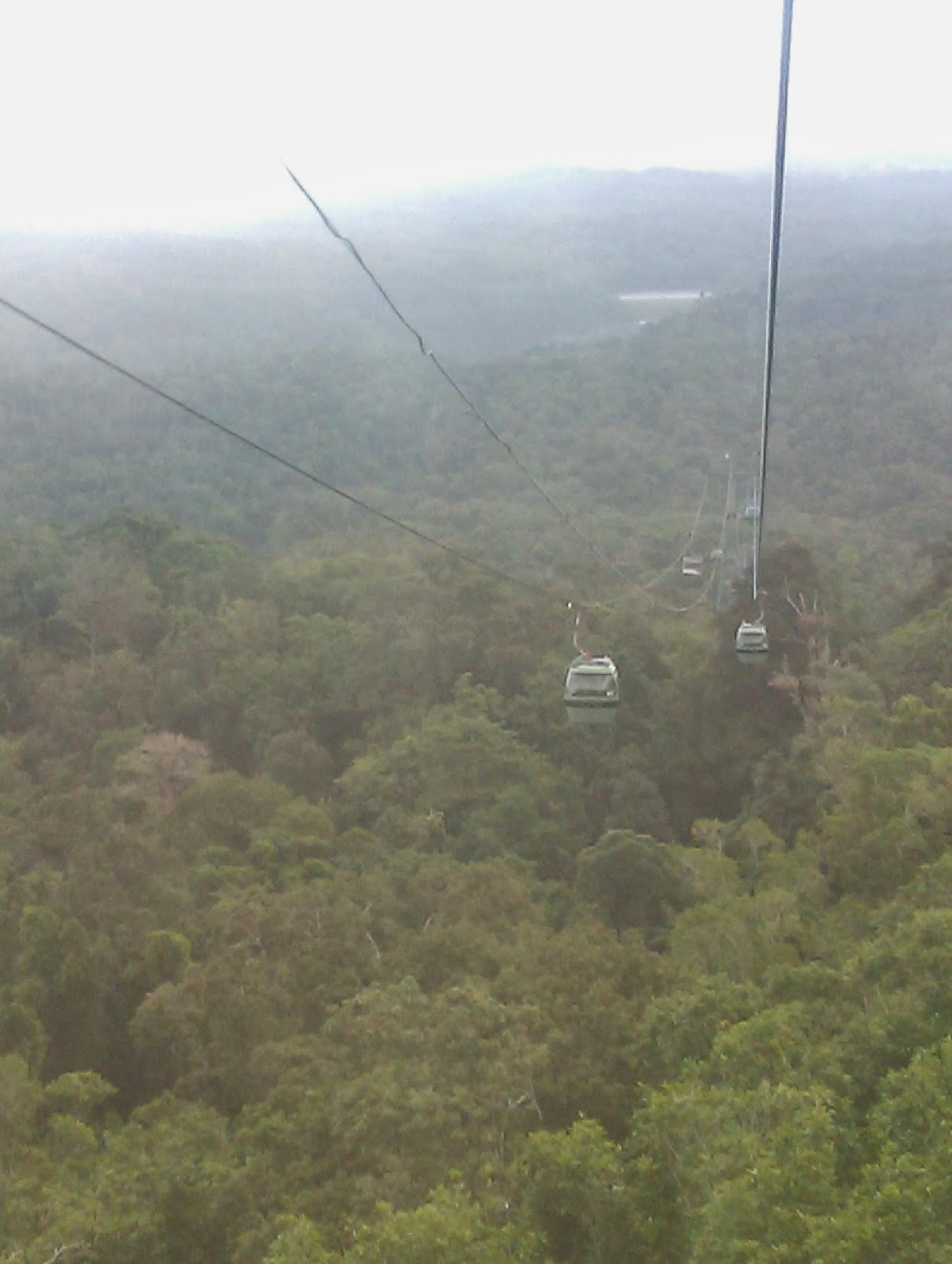
Two views from the Skyrail
The next day was Daintree, which involved a pretty long drive through increasingly jungly terrain. We even crossed the Daintree River on a cable ferry, which is the only way up to Cape Tribulation (so named because Captain Cook had a pretty terrible time there) by road. Kyle, with the jaunty confidence of so many Australians when talking about their native animals, informed me that the Daintree River was absolutely chock-full of crocodiles, so I naturally spent the five-minute crossing with my face pressed to the window for a glimpse, but ended up disappointed.
In fact, every body of water we passed during that week held them, according to him, but I never saw a single one. To compound my disappointment, the day before at Kuranda, we'd stopped for lunch at a German-style sausage place, which advertised exotic meats like crocodile or kangaroo. I duly ordered up a croc sausage, but was balked when they told me it'd take twenty minutes to prepare. I presumed this meant they had to go out and catch one, slaughter it and prepare it, so I forebore, not wanting to put the owners in any further danger, but it's disappointing I didn't get to reassert to the crocodiles of Queensland just who's at the top of the food chain.
By the way, lest you think all Australians are like Crocodile Dundee when it comes to their deadly animals, I was interested to hear that one of the snakes on display at the Venom Zoo had once made its way into Kyle's living room.
"What did you guys do?" I asked, expecting some frontier story about getting a long stick and extracting the snake that way.
"We called animal services and stayed the hell out of there until it was gone," he said, which is kind of reassuring, if you think about it. It typically means pranks won't involve you finding, say, a bird-eating spider in your sheets at the end of the day.
Anyway, the Daintree was impressive too, just as much as Kuranda. For one thing, according to Bill Bryson, a lot of it is pretty much unchanged from the times of the dinosaurs. We didn't see any T-rexes, which is probably for the best, but we did see something even less common (as it were): the cassowary, a large, blue flightless bird that only lives in the forests of Queensland. Not only that, we saw two of them! Even Kyle and his brothers were impressed, because cassowaries are very shy and retiring. This made up for the lack of crocs. And frankly, cassowaries are a little less interested in sampling how you taste, so this is fine with me.

Forest in the Daintree
This is running a little long, so I'll have to gloss over the Great Barrier Reef, except to say that I gave scuba diving a try and found it amazing down there. Even if you only ever snorkel, though, a visit to Far North Queensland should include taking a boat out to the reef, because its diversity is stunning.
The point, though, is that for all the tourism and backpacking that comes to Cairns, and frankly renders parts of it not particularly charming (Kyle told me of a nightclub called Troppo's, which locals had re-christened Sloppo's), it struck me as a part of the world where the man-made and natural worlds live even closer together than in most other places. It's a good thing to keep in mind, because it means the locals are duly wary but not freaked out by having so many dangerous animals around all the time. For instance, I'd timed my visit to avoid the start of stinger season, when box jellyfish make Queensland's waters unapproachable; during stinger season, therefore, Queenslanders simply go to the pool.
I read another blog post once by a woman from Cairns, who said it was a place that wasn't really designed for humans to live in. I disagree - as long as you stay alert and don't do anything stupid, it's a very hospitable place indeed.
Just don't forget about the hurricanes, and don't eat the chiko-rolls.
Sunday, 15 September 2013
Frad Lab World Tour: One Year On, Itchy Feet Set In
Here in the UK, summer's given way, rather abruptly, to fall (as in falling temperatures), and so my thoughts have naturally turned to warmer climes recently. Although in fairness, I've been haunting the travel sections of Big Waterstones and other bookstores since about August, possibly because September is when I've gone on my big, exciting trips to Asia/Australia.
About this time three years ago I was newly returned from Phuket, and this time last year I was still in Queensland in northern Australia, as part of my epic trip to Hong Kong, Sydney and Cairns (well, epic for me). I wrote about the Hong Kong portion of the trip when I got back, because I've long had pretensions of being the next Bill Bryson or Paul Theroux, but I never got around to posting the bits about Sydney or Queensland.
I kind of regret that, of course - I think I had some mordantly witty insights about both places - but I figure I can use this week's post as an excuse to dig out some photos from that trip, and maybe indulge in the time-honored tradition of boring you, my interlocutors, with them. Also, since I took the pics myself I don't need to worry about getting yelled at by rights-holders (a remote possibility, it's true, but still one that concerns me in a vague way).
So, yeah, Sydney:

It's kind of a shame, but this was actually the sort of disappointing part of my trip. Not because there was anything wrong with Sydney - as you can see from the picture above, the weather was amazing and the city itself (at least around Circular Quay) is gorgeous.
But it was disappointing because I only had two days there, and I was on my own. My exploring time was also curtailed by the fact that I desperately had to do some laundry when I landed that first day, and by the fact that I was so worn out by jet lag and overnight flights that I slept until 11am my second, and only full, day there.
But in compensation, I was amazingly excited by being there. On my flight in from Hong Kong, I essentially spent the approach, which goes over the harbor, with my face pressed to the window. And when I finally got into the city, I was struck by Bill Bryson's point in In a Sunburned Country (which the Brits rather unimaginatively style Down Under) that one of the most exciting things about Australia is that it's there.

He says that after traveling so far and so long, you expect at the very least to find yourself someplace where they ride camels and stuff. And it's true! Ignoring the fact that the Australian interior is apparently the only remaining place that dromedaries, the one-humped camels, live in the wild, it's kind of odd to pass over a profusion of names you've never heard in the Philippines, Indonesia, or Malaysia, and end up somewhere that looks like a mixture of New York, LA, and London. In fact, when I was in Sydney I was probably closer to their Newcastle than I usually am to the original when I'm here in London.
The other thing that strikes me now, a year after I went and in the midst of a re-read of In a Sunburned Country (told you I was nostalgic) is how enjoyable it is to read Bryson's description of Circular Quay and realize that I recognized it perfectly, even about 12 or 14 years later. The Harbor Bridge is on your left, the Opera House on your right, and before you is a dazzling expanse of water, bounded on three sides by a concourse filled with shops and street entertainers and people going about their day, just like I would in London but on the complete wrong side of the planet.

To be brutally honest as well, Sydney was a welcome relief from all the noodles with meat I kept having in Hong Kong. In my three days there, I had Western food exactly once: a kebab at the Big Buddha on Lantau, and the rest of the time I ate so many noodles I could have been training for a marathon. Which, come to think of it, I kind of was. So wandering around the streets between Circular Quay and Darling Harbour, I was delighted to find prawn and chicken skewers and pizza and burgers aplenty.
I don't want to denigrate the fine food in Hong Kong, but I like a bit more variety, and it's a well-known point that in Asia, the Western-style food is usually not particularly good. I learned it in Phuket, and so I wasn't going to risk it in Hong Kong. Although that kebab sure hit the spot.
Anyway, one more picture from Sydney before I move on to Queensland:

Bondi turned out to be my big excursion for the second day, because, as I mentioned earlier, I woke up too late to really make the most of the day. I'd been assured at the hotel's front desk that there was a bus stop that went directly to Bondi, so I dutifully trooped up and waited. And waited. And waited some more.
It was Sunday, of course, so buses didn't run as often as normal. Eventually one did show up, and I settled in for what turned out to be a very long ride indeed through Sydney's suburbs. I think there were two complete exchanges of bus passengers in the time I was there.
In compensation, I gained a new perspective into exactly how similar suburban New South Wales is to the suburban Bay Area. Specifically, it looked exactly like Menlo Park or Mountain View or one of the leafier suburbs near where I grew up, right down to the road signs at each corner. The only things that suggested I wasn't back in the Peninsula were the pubs (in particular their Wild West-style gables, so characteristic of Australia, I was to learn) and the local birds, which are way more colorful than anything we get back in Northern California.
Another key difference I was going to mention was the very large Pacific Islander man who sat in front of me late on in the trip, but thinking about it, Pacific Islanders aren't that uncommon in California. So it just made me feel a little more at home.
Anyway, when I did eventually get to Bondi Beach - which in the event did involve a change of bus - I found it full of people enjoying their Sunday. The Aussie guy I'd walked around Hong Kong with that first day had suggested the Breakers for lunch, but in the end I opted for fish and chips at a sandy, loud place right on the beach. I'd seen a fish called barramundi on the menu the previous day, so I wanted to give it a try, although it turned out to be not that different from cod in an English chip shop.
Still, it was nice, and after lunch I walked around, before catching the bus back into the city, where I arrived too late to catch the Australian museum, so I went for a walk around Farm Cove instead and got a bunch more pictures of the water and the Opera House.
For dinner I fulfilled a promise I'd made to myself, to have something you could only get here in Australia, which turned out to be a local variant of surf and turf: kangaroo plus Moreton Bay bugs and other types of local crustaceans. I ate in a restaurant right on the water in Darling Harbour, which was very pretty indeed, although (like Bondi) would probably have been more fun with a traveling companion.
Anyway, this has gone on long enough, so I'll leave Cairns and Queensland for next week or something. But as a parting thought, I've decided I really need to do Sydney properly - my big idea is to rent an apartment there for a month, and use it as a base to explore the southeastern corner of the country. But I figure I'll have to save up, because Sydney was ridiculously expensive (odd to say after coming from Hong Kong, but there you go).
About this time three years ago I was newly returned from Phuket, and this time last year I was still in Queensland in northern Australia, as part of my epic trip to Hong Kong, Sydney and Cairns (well, epic for me). I wrote about the Hong Kong portion of the trip when I got back, because I've long had pretensions of being the next Bill Bryson or Paul Theroux, but I never got around to posting the bits about Sydney or Queensland.
I kind of regret that, of course - I think I had some mordantly witty insights about both places - but I figure I can use this week's post as an excuse to dig out some photos from that trip, and maybe indulge in the time-honored tradition of boring you, my interlocutors, with them. Also, since I took the pics myself I don't need to worry about getting yelled at by rights-holders (a remote possibility, it's true, but still one that concerns me in a vague way).
So, yeah, Sydney:

Nice thing to see on your morning commute, eh?
It's kind of a shame, but this was actually the sort of disappointing part of my trip. Not because there was anything wrong with Sydney - as you can see from the picture above, the weather was amazing and the city itself (at least around Circular Quay) is gorgeous.
But it was disappointing because I only had two days there, and I was on my own. My exploring time was also curtailed by the fact that I desperately had to do some laundry when I landed that first day, and by the fact that I was so worn out by jet lag and overnight flights that I slept until 11am my second, and only full, day there.
But in compensation, I was amazingly excited by being there. On my flight in from Hong Kong, I essentially spent the approach, which goes over the harbor, with my face pressed to the window. And when I finally got into the city, I was struck by Bill Bryson's point in In a Sunburned Country (which the Brits rather unimaginatively style Down Under) that one of the most exciting things about Australia is that it's there.

The obligatory Opera House shot.
He says that after traveling so far and so long, you expect at the very least to find yourself someplace where they ride camels and stuff. And it's true! Ignoring the fact that the Australian interior is apparently the only remaining place that dromedaries, the one-humped camels, live in the wild, it's kind of odd to pass over a profusion of names you've never heard in the Philippines, Indonesia, or Malaysia, and end up somewhere that looks like a mixture of New York, LA, and London. In fact, when I was in Sydney I was probably closer to their Newcastle than I usually am to the original when I'm here in London.
The other thing that strikes me now, a year after I went and in the midst of a re-read of In a Sunburned Country (told you I was nostalgic) is how enjoyable it is to read Bryson's description of Circular Quay and realize that I recognized it perfectly, even about 12 or 14 years later. The Harbor Bridge is on your left, the Opera House on your right, and before you is a dazzling expanse of water, bounded on three sides by a concourse filled with shops and street entertainers and people going about their day, just like I would in London but on the complete wrong side of the planet.

Circular Quay from the water
To be brutally honest as well, Sydney was a welcome relief from all the noodles with meat I kept having in Hong Kong. In my three days there, I had Western food exactly once: a kebab at the Big Buddha on Lantau, and the rest of the time I ate so many noodles I could have been training for a marathon. Which, come to think of it, I kind of was. So wandering around the streets between Circular Quay and Darling Harbour, I was delighted to find prawn and chicken skewers and pizza and burgers aplenty.
I don't want to denigrate the fine food in Hong Kong, but I like a bit more variety, and it's a well-known point that in Asia, the Western-style food is usually not particularly good. I learned it in Phuket, and so I wasn't going to risk it in Hong Kong. Although that kebab sure hit the spot.
Anyway, one more picture from Sydney before I move on to Queensland:

Bondi Beach
Bondi turned out to be my big excursion for the second day, because, as I mentioned earlier, I woke up too late to really make the most of the day. I'd been assured at the hotel's front desk that there was a bus stop that went directly to Bondi, so I dutifully trooped up and waited. And waited. And waited some more.
It was Sunday, of course, so buses didn't run as often as normal. Eventually one did show up, and I settled in for what turned out to be a very long ride indeed through Sydney's suburbs. I think there were two complete exchanges of bus passengers in the time I was there.
In compensation, I gained a new perspective into exactly how similar suburban New South Wales is to the suburban Bay Area. Specifically, it looked exactly like Menlo Park or Mountain View or one of the leafier suburbs near where I grew up, right down to the road signs at each corner. The only things that suggested I wasn't back in the Peninsula were the pubs (in particular their Wild West-style gables, so characteristic of Australia, I was to learn) and the local birds, which are way more colorful than anything we get back in Northern California.
Another key difference I was going to mention was the very large Pacific Islander man who sat in front of me late on in the trip, but thinking about it, Pacific Islanders aren't that uncommon in California. So it just made me feel a little more at home.
Anyway, when I did eventually get to Bondi Beach - which in the event did involve a change of bus - I found it full of people enjoying their Sunday. The Aussie guy I'd walked around Hong Kong with that first day had suggested the Breakers for lunch, but in the end I opted for fish and chips at a sandy, loud place right on the beach. I'd seen a fish called barramundi on the menu the previous day, so I wanted to give it a try, although it turned out to be not that different from cod in an English chip shop.
Still, it was nice, and after lunch I walked around, before catching the bus back into the city, where I arrived too late to catch the Australian museum, so I went for a walk around Farm Cove instead and got a bunch more pictures of the water and the Opera House.
For dinner I fulfilled a promise I'd made to myself, to have something you could only get here in Australia, which turned out to be a local variant of surf and turf: kangaroo plus Moreton Bay bugs and other types of local crustaceans. I ate in a restaurant right on the water in Darling Harbour, which was very pretty indeed, although (like Bondi) would probably have been more fun with a traveling companion.
Anyway, this has gone on long enough, so I'll leave Cairns and Queensland for next week or something. But as a parting thought, I've decided I really need to do Sydney properly - my big idea is to rent an apartment there for a month, and use it as a base to explore the southeastern corner of the country. But I figure I'll have to save up, because Sydney was ridiculously expensive (odd to say after coming from Hong Kong, but there you go).
Saturday, 7 September 2013
Where Have All the German-Speakers Gone?
As I may have hinted before on this blog, I spend a lot of time in the travel section at local bookstores (and lately I've been spending even more time there, as the Waterstones on Piccadilly recently turned its entire basement into a travel section, and even divided everything up by region, as I like it). A year or so ago, I started noticing books about Germany popping up on the shelves.
The first was called Springtime for Germany: or How I Learned to Love Lederhosen, by Ben Donald, and used the device of a fictional "travel therapist" (American, of course) to "re-introduce" Germany to British readers. I never picked it up, but based on the Amazon reviews, I'm pretty glad I skipped it - Donald seems unable to leave aside the German stereotypes, as one can tell from the title, which is a two-fer featuring Nazism and lederhosen.
One I did pick up was Germania, by Simon Winder, which is less a travel book than history. Winder did a good job of unpicking the rather complicated history of Germany from classical times to 1933, and did it without speaking a lick of German. So, emboldened, I ventured back into the history section and picked up The German Genius, by Peter Watson, which I'm still working my way through, and have leafed through a few other books here and there.
But the takeaway here is, I find it fascinating that the British are suddenly so into Germany again. In the beginning of his book, Watson talks about the British view of Germany, which is sometimes still distorted by the tabloids. But even talking to my own friends - people who don't read the Sun, and in fact have spent time living abroad - Germany's kind of a mystery. One friend admitted that the country's always been a mystery to him, in part because of stories he heard from his grandfather growing up.
(Another friend, oddly enough, got really annoyed at me when I used the phrase "re-introducing Germany to Britain", although I suspect that was more because he thought I was criticizing Britain.)
I'm not surprised, though, because when I moved here for the first time, in 2001, I was coming straight from Germany, and it seemed like nobody here knew anything about the place. Well, apart from football-related stuff - the fall of 2001 was when England handed Germany a 5-1 drubbing in Munich on the way to the 2002 World Cup. But that knowledge really only served to obscure the rest of the country - nobody seemed to know German, for example (which is why I keep getting jobs here).
In fact, the immediate spur to writing this post was a passage on travel website "The Man in Seat 61", where he directs us to a website but warns that it's all in German, so we should use Google Translate to get through the process. What I found strange about it was the assumption that nobody reading his site would speak German - it's a language spoken by around 95 million people around the world (and me!), so not too far off from Japanese and well ahead of French or Italian. If I pass on a link at work, I always say if it's in a language other than English, but that's just politeness - in fact, if I pass on a link about Germany my assumption is that at least some readers will know the language.
The point here is, Britain (and America, which almost as bad) should go ahead and learn some German. I'd like to find more books like Winder's Germania on the shelves in the travel or history sections of a bookstore, and less of the interminable books about World War II or the Nazis.
And when I say that, I don't mean to minimize the Holocaust in any way, I just mean that there's so much more to the country that's being obscured by the obsession with the years 1933-1945. It's time we resurrected that history.
The first was called Springtime for Germany: or How I Learned to Love Lederhosen, by Ben Donald, and used the device of a fictional "travel therapist" (American, of course) to "re-introduce" Germany to British readers. I never picked it up, but based on the Amazon reviews, I'm pretty glad I skipped it - Donald seems unable to leave aside the German stereotypes, as one can tell from the title, which is a two-fer featuring Nazism and lederhosen.
One I did pick up was Germania, by Simon Winder, which is less a travel book than history. Winder did a good job of unpicking the rather complicated history of Germany from classical times to 1933, and did it without speaking a lick of German. So, emboldened, I ventured back into the history section and picked up The German Genius, by Peter Watson, which I'm still working my way through, and have leafed through a few other books here and there.
But the takeaway here is, I find it fascinating that the British are suddenly so into Germany again. In the beginning of his book, Watson talks about the British view of Germany, which is sometimes still distorted by the tabloids. But even talking to my own friends - people who don't read the Sun, and in fact have spent time living abroad - Germany's kind of a mystery. One friend admitted that the country's always been a mystery to him, in part because of stories he heard from his grandfather growing up.
(Another friend, oddly enough, got really annoyed at me when I used the phrase "re-introducing Germany to Britain", although I suspect that was more because he thought I was criticizing Britain.)
I'm not surprised, though, because when I moved here for the first time, in 2001, I was coming straight from Germany, and it seemed like nobody here knew anything about the place. Well, apart from football-related stuff - the fall of 2001 was when England handed Germany a 5-1 drubbing in Munich on the way to the 2002 World Cup. But that knowledge really only served to obscure the rest of the country - nobody seemed to know German, for example (which is why I keep getting jobs here).
In fact, the immediate spur to writing this post was a passage on travel website "The Man in Seat 61", where he directs us to a website but warns that it's all in German, so we should use Google Translate to get through the process. What I found strange about it was the assumption that nobody reading his site would speak German - it's a language spoken by around 95 million people around the world (and me!), so not too far off from Japanese and well ahead of French or Italian. If I pass on a link at work, I always say if it's in a language other than English, but that's just politeness - in fact, if I pass on a link about Germany my assumption is that at least some readers will know the language.
The point here is, Britain (and America, which almost as bad) should go ahead and learn some German. I'd like to find more books like Winder's Germania on the shelves in the travel or history sections of a bookstore, and less of the interminable books about World War II or the Nazis.
And when I say that, I don't mean to minimize the Holocaust in any way, I just mean that there's so much more to the country that's being obscured by the obsession with the years 1933-1945. It's time we resurrected that history.
Saturday, 31 August 2013
Sponsorships, or Fox Guards Henhouse
One of the benefits of working for my company is that in August we get Friday afternoons off. It's a nice way to get a start on the weekend, whether by getting stuff done, leaving town or just visiting tourist spots that would be prohibitively crowded on weekends.
That was my plan this latest Friday, the last one of the month. I'd been reading David Toomey's Weird Life recently, and wanted to go check out the Natural History Museum and see if it had anything about that stuff. During the week, I also got talking to one of my colleagues, who'd been to an exhibition of pictures by Sebastiao Salgado, a Brazilian photographer; she said it was amazing, so I duly bought my ticket and went to check it out.
Salgado's pictures are mostly concerned with natural life and with indigenous cultures, generally in extreme environments - some were of the San people of Africa, others of Antarctica and still others of the native tribes in the Amazon. With the pictures of tribal peoples, in particular, he conveyed the sense that they have been living the same way of life for thousands of years - at least, as much as you can convey that sense by taking pictures of them.
Still, it was beautiful and thought-provoking in the way it made me think of the fragility of these people's lives and social systems, and the poignancy of the gulf between their way of life and mine. I don't want to romanticize it too much, but the people he snapped in the jungles of South America and Papua gave the impression of not wanting much - they live in a place that appears to provide them all they need, as long as they remain within balance with it.
I'm probably imposing a lot of my own world view on them, but if nothing else, it's interesting to see that there are still societies living like that. Of course, their ways of life are generally under threat from development, mining and - let's be honest - enormous poverty. They are minorities in their own countries, and generally without a voice, because they don't interact much with the outside world.
In any case, these were my thoughts until I got to the end of the exhibition. That's when I saw the sponsor: Brazilian mining company Vale. I'll admit I'd never heard of Vale before that moment, but the wrongness hit me immediately, even despite their rhetoric about corporate social responsibility. Just for good measure, I had a quick look for them on my phone, and turned up this tidbit about them "winning" the Public Eye award for having the most "contempt for the environment and human rights in the world".
Frankly it's not important whether or not Public Eye's allegations are founded or not, though. It could be run by the nicest people in the world, but at the end of the day a mining company exists to rip valuable materials out of the ground, regardless of what's covering them. There is absolutely no way to square that activity with protecting fragile ecosystems or the territories of indigenous peoples. Not one.
So you can imagine that on making that discovery I was not incredibly impressed. To be honest, it's still bothering me twenty-four hours later (hence this blog post). What did intrigue me, though, was how the feedback sheets provided by the museum asked us specifically about the sponsor and whether we knew of it before (I took the opportunity to point out my displeasure at that selection); even more intriguing is the fact that the posters on the tube advertising the exhibition carry no mention at all of the sponsor.
Usually special exhibitions at London's museums are emblazoned with the sponsors' logos. BP is one that keeps appearing, for instance. This raises a question or two - does the Natural History Museum believe advertising the sponsorship by Vale would put people off, or just that nobody would recognize the name? Or, given that they point out how the original sponsors pulled out and Vale kindly stepped in at the last minute, are they even the slightest bit embarrassed by the connection?
It's a little too much to expect, frankly - but I hope they are.
That was my plan this latest Friday, the last one of the month. I'd been reading David Toomey's Weird Life recently, and wanted to go check out the Natural History Museum and see if it had anything about that stuff. During the week, I also got talking to one of my colleagues, who'd been to an exhibition of pictures by Sebastiao Salgado, a Brazilian photographer; she said it was amazing, so I duly bought my ticket and went to check it out.
Salgado's pictures are mostly concerned with natural life and with indigenous cultures, generally in extreme environments - some were of the San people of Africa, others of Antarctica and still others of the native tribes in the Amazon. With the pictures of tribal peoples, in particular, he conveyed the sense that they have been living the same way of life for thousands of years - at least, as much as you can convey that sense by taking pictures of them.
Still, it was beautiful and thought-provoking in the way it made me think of the fragility of these people's lives and social systems, and the poignancy of the gulf between their way of life and mine. I don't want to romanticize it too much, but the people he snapped in the jungles of South America and Papua gave the impression of not wanting much - they live in a place that appears to provide them all they need, as long as they remain within balance with it.
I'm probably imposing a lot of my own world view on them, but if nothing else, it's interesting to see that there are still societies living like that. Of course, their ways of life are generally under threat from development, mining and - let's be honest - enormous poverty. They are minorities in their own countries, and generally without a voice, because they don't interact much with the outside world.
In any case, these were my thoughts until I got to the end of the exhibition. That's when I saw the sponsor: Brazilian mining company Vale. I'll admit I'd never heard of Vale before that moment, but the wrongness hit me immediately, even despite their rhetoric about corporate social responsibility. Just for good measure, I had a quick look for them on my phone, and turned up this tidbit about them "winning" the Public Eye award for having the most "contempt for the environment and human rights in the world".
Frankly it's not important whether or not Public Eye's allegations are founded or not, though. It could be run by the nicest people in the world, but at the end of the day a mining company exists to rip valuable materials out of the ground, regardless of what's covering them. There is absolutely no way to square that activity with protecting fragile ecosystems or the territories of indigenous peoples. Not one.
So you can imagine that on making that discovery I was not incredibly impressed. To be honest, it's still bothering me twenty-four hours later (hence this blog post). What did intrigue me, though, was how the feedback sheets provided by the museum asked us specifically about the sponsor and whether we knew of it before (I took the opportunity to point out my displeasure at that selection); even more intriguing is the fact that the posters on the tube advertising the exhibition carry no mention at all of the sponsor.
Usually special exhibitions at London's museums are emblazoned with the sponsors' logos. BP is one that keeps appearing, for instance. This raises a question or two - does the Natural History Museum believe advertising the sponsorship by Vale would put people off, or just that nobody would recognize the name? Or, given that they point out how the original sponsors pulled out and Vale kindly stepped in at the last minute, are they even the slightest bit embarrassed by the connection?
It's a little too much to expect, frankly - but I hope they are.
Sunday, 25 August 2013
The Lost Continent
One of the many books I'm reading currently (by which I mean keep a bookmark in) is The Lost Continent, Bill Bryson's first travel narrative and a description of his trip across the continental US soon after the death of his father. Like all debut books, I get the sense that it generally sank without a trace at its first publication, a fact he alludes to in his next book, Neither Here Nor There. In fact I believe both books were completely ignored by the British book-buying public until he came out with Notes from a Small Island, which just goes to show that nobody pays attention to you until you start talking about them.
In any case, ignored or not, I end up re-reading the Lost Continent every couple of years (along with In A Sunburned Country, which is published here as Down Under), because I'm fascinated by his take on America at the time, and because he has an amazing gift for metaphor. But in the midst of the current re-read I was struck by something odd: he devotes almost as much space in the book to Philadelphia as he does to New York City, and the state of Pennsylvania gets twice as many pages as all of New York State (yes, I just went back and counted).
Now, part of this is because of the vagaries of Bryson's itinerary. He had access to a car for the Pennsylvania section, but got to New York by bus. This, and his route up the coast toward New England, is why he doesn't have anything to say about upstate New York. But I still found it kind of odd, because Philadelphia, as far as I can tell, doesn't appear to be part of the cultural conversation in any way.
Obviously most foreigners think of New York City when they think of America, which is fair enough because it is, in many ways, the cultural epicenter of Anglophone civilization (some British patriots might say it's London, but London spends so much time trying to become New York that I think it's clear which is the more influential city). They're also familiar with Los Angeles, and in a more nebulous way with San Francisco, although charmingly they aren't aware that the two cities aren't right next to each other, as they appear on maps.
New Orleans and Chicago and Boston are well-known, as is Washington DC, all for obvious reasons. Baltimore is also on the cultural map, because of the Wire, but Philadelphia? It's rare that I hear anybody mention the place these days, except in the context of how they put up a statue to Rocky Balboa (in fairness, there's also the sitcom It's Always Sunny in Philadelphia, but that doesn't seem to be A Thing like the Wire was).
So this was why I was struck by Bryson's description of the place, with unknown treasures and even its own dialect of sorts (I was reminded by the book that Philadelphians call sidewalks "pavements"). I was even more struck by the fact that when he got to New York, he had to introduce key features of it, like Donald Trump or Times Square, and that he was constantly in fear of mugging and/or murder.
The latter can be explained by the fact that he was writing in 1989 or so, which puts it during the late Ed Koch's mayorship of the city. He was about four years off from the Giuliani years, so deep within New York City's dark period, something that I think New Yorkers haven't really recovered from, at least based on my mom's impression of Columbia, way up in the 120s (what she still calls Harlem), when I was going there.
Harder to conceive is the idea that anyone reading the Lost Continent might be unfamiliar with Times Square, or even Donald Trump. Because New York's emergence from the squalor of the 70s and 80s coincided with my awareness of the place, I find it hard to get away from its current glitzy image as a shopping mecca (incidentally, that's why I call it the Anglophone world's cultural capital, not because it's got better museums or art or publishing). Even when I moved here for the first time in 2001, people in London knew about Manhattan, Times Square, all of that stuff - shows like Sex and the City were even then working their way in the cultural consciousness.
But then, I guess that's what happens as time passes (I'm aware this is a subject I've been covering a lot recently on this blog, but please bear with me). We are now almost as distant from the publication of the Lost Continent as Bill Bryson himself was from the vacations he describes taking with his family in the late 1950s and early 1960s. In the past three decades the world has grown more interconnected, so that a person in London (or Sao Paulo, or Mumbai, or wherever) actually is familiar with what life is like in New York - or at least life for certain socio-economic strata.
At the same time, though I think it's a shame that the world's image of America has narrowed onto primarily New York and LA. As I hinted in the previous paragraph, we may know about life in New York, but it's mainly from the perspective of rich white people who can afford to live there. Even the polarizing Lena Dunham show Girls depicts a certain class of people who are pretty divorced from life in the Outer Boroughs.
By being so interested in what shoes rich white socialites are wearing, we miss out on seeing what life is like for normal people in places like, say, Baltimore or New Orleans or Philadelphia. When I watch Friday Night Lights, which is set in small-town Texas, it's clear that you aren't seeing the same America that Carrie Bradshaw lives in.
I'd like to see more of it - so where are the dramas set in Philadelphia?
In any case, ignored or not, I end up re-reading the Lost Continent every couple of years (along with In A Sunburned Country, which is published here as Down Under), because I'm fascinated by his take on America at the time, and because he has an amazing gift for metaphor. But in the midst of the current re-read I was struck by something odd: he devotes almost as much space in the book to Philadelphia as he does to New York City, and the state of Pennsylvania gets twice as many pages as all of New York State (yes, I just went back and counted).
Now, part of this is because of the vagaries of Bryson's itinerary. He had access to a car for the Pennsylvania section, but got to New York by bus. This, and his route up the coast toward New England, is why he doesn't have anything to say about upstate New York. But I still found it kind of odd, because Philadelphia, as far as I can tell, doesn't appear to be part of the cultural conversation in any way.
Obviously most foreigners think of New York City when they think of America, which is fair enough because it is, in many ways, the cultural epicenter of Anglophone civilization (some British patriots might say it's London, but London spends so much time trying to become New York that I think it's clear which is the more influential city). They're also familiar with Los Angeles, and in a more nebulous way with San Francisco, although charmingly they aren't aware that the two cities aren't right next to each other, as they appear on maps.
New Orleans and Chicago and Boston are well-known, as is Washington DC, all for obvious reasons. Baltimore is also on the cultural map, because of the Wire, but Philadelphia? It's rare that I hear anybody mention the place these days, except in the context of how they put up a statue to Rocky Balboa (in fairness, there's also the sitcom It's Always Sunny in Philadelphia, but that doesn't seem to be A Thing like the Wire was).
So this was why I was struck by Bryson's description of the place, with unknown treasures and even its own dialect of sorts (I was reminded by the book that Philadelphians call sidewalks "pavements"). I was even more struck by the fact that when he got to New York, he had to introduce key features of it, like Donald Trump or Times Square, and that he was constantly in fear of mugging and/or murder.
The latter can be explained by the fact that he was writing in 1989 or so, which puts it during the late Ed Koch's mayorship of the city. He was about four years off from the Giuliani years, so deep within New York City's dark period, something that I think New Yorkers haven't really recovered from, at least based on my mom's impression of Columbia, way up in the 120s (what she still calls Harlem), when I was going there.
Harder to conceive is the idea that anyone reading the Lost Continent might be unfamiliar with Times Square, or even Donald Trump. Because New York's emergence from the squalor of the 70s and 80s coincided with my awareness of the place, I find it hard to get away from its current glitzy image as a shopping mecca (incidentally, that's why I call it the Anglophone world's cultural capital, not because it's got better museums or art or publishing). Even when I moved here for the first time in 2001, people in London knew about Manhattan, Times Square, all of that stuff - shows like Sex and the City were even then working their way in the cultural consciousness.
But then, I guess that's what happens as time passes (I'm aware this is a subject I've been covering a lot recently on this blog, but please bear with me). We are now almost as distant from the publication of the Lost Continent as Bill Bryson himself was from the vacations he describes taking with his family in the late 1950s and early 1960s. In the past three decades the world has grown more interconnected, so that a person in London (or Sao Paulo, or Mumbai, or wherever) actually is familiar with what life is like in New York - or at least life for certain socio-economic strata.
At the same time, though I think it's a shame that the world's image of America has narrowed onto primarily New York and LA. As I hinted in the previous paragraph, we may know about life in New York, but it's mainly from the perspective of rich white people who can afford to live there. Even the polarizing Lena Dunham show Girls depicts a certain class of people who are pretty divorced from life in the Outer Boroughs.
By being so interested in what shoes rich white socialites are wearing, we miss out on seeing what life is like for normal people in places like, say, Baltimore or New Orleans or Philadelphia. When I watch Friday Night Lights, which is set in small-town Texas, it's clear that you aren't seeing the same America that Carrie Bradshaw lives in.
I'd like to see more of it - so where are the dramas set in Philadelphia?
Sunday, 18 August 2013
Rate of Change
I'm currently reading The Shining Girls, by Lauren Beukes, as a result of an outpouring of enthusiasm on Twitter, along with Amazon UK pricing it at 99p a few weeks ago as part of a special promotion. It's not bad, but I have to admit I'm not loving it - I'm not much for thrillers in general, and the ones about serial killers have never appealed to me.
But something struck me while I was reading it, which I figured I'd try and discuss briefly here. The plot, without any major spoilers (because I'm only about halfway through anyway), revolves around a serial killer who travels through time, between the 1930s and the early 1990s, collecting victims in an order of his own choosing, rather than chronologically. At one point, reflecting on the House he uses to travel, he notes that his range of travel is limited to those years, with 1993 the latest he can go.
Having glanced through the table of contents, with chapters denoting the date in which they occur, I'd noticed that, and was wondering about it myself. My conclusion was that 1993 was probably the last year before the internet started to become widely known - it was certainly my first experience of it (and just as you'd expect from the early years of the web: reading snarky top ten lists about Star Wars and Star Trek).
This is important to the story, because one of the killer's victims survives an attack, and when she's recovered she goes looking for him by taking on an internship at the Chicago Sun-Times. All of her research is analogue, involving microfiche and sifting through loads of boxes.
So what struck me was this: a possible reason why Lauren Beukes set her story during those decades is that the internet would have made the search for the killer much easier, and that those decades were a lot more similar to one another than the years since the internet spread throughout our culture.
I've written before about how I think the 80s had more in common with the 50s than with the 90s. I might be over-generalizing, but I do think it's correct to say that the rate of change in our culture has accelerated since the internet took over. As I stated in that previous post, my sisters' experiences growing up were pretty different from my own, and this was with just seven and ten years of age gap between us all. I grew up watching Sesame Street, Mr Rogers, and reruns of Star Trek and Hawaii 5-0 and old Western TV shows; they had Barney and cable TV.
This is why, whenever I read Bill Bryson's more autobiographical books - like The Lost Continent or Life and Times of the Thunderbolt Kid - I can recognize certain aspects of my own childhood in his, despite the fact that he was born almost thirty years before I was. And going back even further, I can recognize some of what Bryson talks about in stories and sketches by, for instance, James Thurber, who died in 1961 and whose career spanned the 30s, 40s and 50s.
So when I think of the life I'd like to lead, if I ever marry and have children and all of that, my imagination uses my own childhood milieu as a template: suburban house, car, yard, dog and/or cat (I like both), family trips once or twice a year, and so on. On the other hand, this all might be unrealistic, for the simple reason that it's not sustainable anymore. If it ever was.
For one thing, house prices are way out of reach for most people, I'd say, particularly if they're single and not working in finance or tech. For another, every place is getting more and more crowded. It seems perverse to say this about California, when I live in London (which I sometimes find unbearably full; I kind of dread going to China as a result), but it's true - developments creep out farther and farther each year, and the freeways are crowded even at midday on weekdays.
So no house in the suburbs, which means no yard, probably no car (because they're a pain in the ass to have in the city), and probably no pets (not that I particularly want to clean up dog shit - this is one of those jobs that I could theoretically farm out to my notional children), because landlords are strict about that and apartments are no fun for animals that need space.
On the other hand, this life that I'd like, and that currently appears out of reach, is kind of a new development in and of itself, despite already being a relic. This concept of a suburban middle class, which a lot of us seem wedded to, has really only existed since the early 20th century, where before the middle classes (or mercantile classes, if you go back far enough) lived in the cities. Naturally, technology moved on between the Middle Ages and the Enlightenment, but not quite as fast as it did following the Industrial Revolution (and the rate of change sped up even more once we got flight and cars and electricity).
So I guess the whole convoluted point comes down to this: I'm kind of nostalgic for a way of life that seems to have been around for a long time, but actually wasn't. My grandmother - who was born in 1917, when flight was still new - probably saw the suburban way of life of the 50s and 60s and 70s as a new innovation, compared to her own upbringing.
The question, then, is what kind of life people just graduating from college now are envisioning for themselves. And further, will that gap between wishes and reality be even wider for them than it is for me?
But something struck me while I was reading it, which I figured I'd try and discuss briefly here. The plot, without any major spoilers (because I'm only about halfway through anyway), revolves around a serial killer who travels through time, between the 1930s and the early 1990s, collecting victims in an order of his own choosing, rather than chronologically. At one point, reflecting on the House he uses to travel, he notes that his range of travel is limited to those years, with 1993 the latest he can go.
Having glanced through the table of contents, with chapters denoting the date in which they occur, I'd noticed that, and was wondering about it myself. My conclusion was that 1993 was probably the last year before the internet started to become widely known - it was certainly my first experience of it (and just as you'd expect from the early years of the web: reading snarky top ten lists about Star Wars and Star Trek).
This is important to the story, because one of the killer's victims survives an attack, and when she's recovered she goes looking for him by taking on an internship at the Chicago Sun-Times. All of her research is analogue, involving microfiche and sifting through loads of boxes.
So what struck me was this: a possible reason why Lauren Beukes set her story during those decades is that the internet would have made the search for the killer much easier, and that those decades were a lot more similar to one another than the years since the internet spread throughout our culture.
I've written before about how I think the 80s had more in common with the 50s than with the 90s. I might be over-generalizing, but I do think it's correct to say that the rate of change in our culture has accelerated since the internet took over. As I stated in that previous post, my sisters' experiences growing up were pretty different from my own, and this was with just seven and ten years of age gap between us all. I grew up watching Sesame Street, Mr Rogers, and reruns of Star Trek and Hawaii 5-0 and old Western TV shows; they had Barney and cable TV.
This is why, whenever I read Bill Bryson's more autobiographical books - like The Lost Continent or Life and Times of the Thunderbolt Kid - I can recognize certain aspects of my own childhood in his, despite the fact that he was born almost thirty years before I was. And going back even further, I can recognize some of what Bryson talks about in stories and sketches by, for instance, James Thurber, who died in 1961 and whose career spanned the 30s, 40s and 50s.
So when I think of the life I'd like to lead, if I ever marry and have children and all of that, my imagination uses my own childhood milieu as a template: suburban house, car, yard, dog and/or cat (I like both), family trips once or twice a year, and so on. On the other hand, this all might be unrealistic, for the simple reason that it's not sustainable anymore. If it ever was.
For one thing, house prices are way out of reach for most people, I'd say, particularly if they're single and not working in finance or tech. For another, every place is getting more and more crowded. It seems perverse to say this about California, when I live in London (which I sometimes find unbearably full; I kind of dread going to China as a result), but it's true - developments creep out farther and farther each year, and the freeways are crowded even at midday on weekdays.
So no house in the suburbs, which means no yard, probably no car (because they're a pain in the ass to have in the city), and probably no pets (not that I particularly want to clean up dog shit - this is one of those jobs that I could theoretically farm out to my notional children), because landlords are strict about that and apartments are no fun for animals that need space.
On the other hand, this life that I'd like, and that currently appears out of reach, is kind of a new development in and of itself, despite already being a relic. This concept of a suburban middle class, which a lot of us seem wedded to, has really only existed since the early 20th century, where before the middle classes (or mercantile classes, if you go back far enough) lived in the cities. Naturally, technology moved on between the Middle Ages and the Enlightenment, but not quite as fast as it did following the Industrial Revolution (and the rate of change sped up even more once we got flight and cars and electricity).
So I guess the whole convoluted point comes down to this: I'm kind of nostalgic for a way of life that seems to have been around for a long time, but actually wasn't. My grandmother - who was born in 1917, when flight was still new - probably saw the suburban way of life of the 50s and 60s and 70s as a new innovation, compared to her own upbringing.
The question, then, is what kind of life people just graduating from college now are envisioning for themselves. And further, will that gap between wishes and reality be even wider for them than it is for me?
Subscribe to:
Posts (Atom)