Another Champions League has come and gone, and a new club has been crowned the best in Europe, at least until next year. By beating Bundesliga rivals Borussia Dortmund last night, Bayern Munich won its fifth Champions League title, to go along with having won the German championship this season; Bayern also stands the chance of making a sweep of the silverware this year, if it beats Stuttgart for the DFB-Pokal, the German equivalent of the FA Cup.
The game itself wasn't exactly one for the ages; the first half was characterized by dominance shifting from one half of the pitch to the other, while the goals only started coming in the second half. Of course, both of the previous times that teams from the same country faced each other the Champions League was decided by penalties (Chelsea v Manchester United in 2008, and Juventus v AC Milan in 2003), so this was at least an improvement.
More important, though, is what this portends for the European game in general. Last year I suggested that most of the previous decade had been a period of dominance for English clubs, although I also suggested this dominance was slightly illusory, given that no English team had won in open play during that time (including, as I said, in 2008). But I still believe that whenever a team gets to the Champions League final, year after year, win or lose, they are clearly the best in Europe. And by that measure, even if they'd lost last Bayern would still be Europe's strongest team, having reached the final last year and in 2010.
Will the next few years see German dominance of European football? I think it's a good bet (and I'm not the only one), particularly as Germany has finally knocked Italy out of the top tier of Champions League countries, and will send four teams to next year's competition, rather than just three.
It's also worth considering the performance of the German national team over the previous years. Germany's reached the final or semi-final of every major international tournament since 2006, by playing fast, attacking football that relies on carving opposing defenses open with excellent passing and fluid movement. For other countries, the strength of the national team would be less lightly correlated with that of individual club teams, but the Bundesliga is probably the best league for homegrown talent, better even than the Spanish league (notwithstanding Barcelona, which is effectively the Spanish national team plus Lionel Messi). In 2005, for instance, when AC Milan faced Liverpool in the Champions League final there were only three Italian and three English players starting for either team.
The key to this success, of course, has been Germany's excellent youth policy, which allowed the German FA to bring talented young players into the team quickly every couple of years; players like Lukas Podolski or Bastian Schweinsteiger, who made their first appearances in 2004, are now well established in the national set-up. They're unlikely to win next year's World Cup, because it'll be in Brazil, which has been waiting over half a century to win the World Cup on home soil, but look out for them to get to the semi-final again, at the very least.
To sum up, if connoisseurs of football were following Italy's Serie A in the 90s and Spain's Primera Liga in the 00s, then this decade already looks like it belongs to the Bundesliga.
Sunday, 26 May 2013

Sunday, 19 May 2013
Meeting Your Heroes
This week, the very day I got back to London from New York, I got to catch a show by Chris Hardwick at the Leicester Square Theatre. I heard about it before leaving, and dutifully bought tickets and roped a friend into coming, despite the late hour (10pm). The show itself was lots of fun, as he spent most of it talking to the crowd rather than doing his Mandroid set or testing out lots of new material.

After the show, he came out and talked to the fans, as in a receiving line, so that we could each get a picture with him and get him to sign our copies of his book. Despite the jet-lag, he was able to muster a cheery manner with me (it probably helped I was close to the front of the line), and we chatted a little about the Bay Area. Gratifyingly, I made him laugh a couple of times, at my reaction to our first attempt at a photo (I really need a new phone), and at my description of my own job.
And then it was over. The theater didn't want us hanging around too late, so we kind of had to hurry through the whole encounter. Naturally, I felt like there was loads more interesting stuff I could have said to him, like how I write fantasy and science fiction, so over the last couple of days I've been thinking about how to get across more about myself in a short time.
Now, one of the themes Chris Hardwick himself has talked about frequently on his podcast is how to react when meeting a famous person you like; the two best interviews he did on this subject were with Tom Wilson and Zach Braff. I seem to remember in the latter interview he pointed out how a fan only has a very short time to engage with them, so it's natural to kind of want to throw everything out at once. But, as per Tom Wilson, the problem is that for that fan it's possibly the only time they interact with the celebrity, whereas the celebrity has that same conversation every single day with different fans.
So overall, I feel like I was pretty good about the whole thing: I didn't fawn too much about how much I loved his book or his podcast or his comedy (why would I be there, otherwise?); I was polite to his girlfriend, Chloe, who was kind enough to be taking time out of their (presumably rare) vacation together to be taking pictures of him and his fans; and if I feel like I could have added something clever about my fiction writing, then I console myself with the thought that, for what it's worth, I'll probably be able to mention it to him at another signing sometime in the future (and with luck I'll be a little further along with it than I am now).
Looking back over that paragraph as well, it occurs to me that probably what I wanted was validation, in the form of, "Hey, that's really cool, good job!" Obviously, I got that reaction from family and friends when a story of mine got published online in January, but to some extent I suppose telling it to one of my heroes is probably about showing them that I'm getting to their rarefied level, and not just some wage slave out enjoying himself for a night.
Hopefully that doesn't seem too harsh, but it feels about right. If you meet your hero, you want to know that you made some kind of impression, that the experience was anywhere near as meaningful to them as it was to you; some people do that by trolling online, I suppose. I've resigned myself to the thought that I probably won't stick in Chris's memory (not like the girl who came from Italy dressed as a Weeping Angel, anyway, but I'm not much of a Dr Who fan), but at the very least, I won't be remembered as a complete jerk. And as I said, I'll wow him next time.
In any case, I'll close with these words of wisdom from Tom Wilson himself, or Biff from Back to the Future:

After the show, he came out and talked to the fans, as in a receiving line, so that we could each get a picture with him and get him to sign our copies of his book. Despite the jet-lag, he was able to muster a cheery manner with me (it probably helped I was close to the front of the line), and we chatted a little about the Bay Area. Gratifyingly, I made him laugh a couple of times, at my reaction to our first attempt at a photo (I really need a new phone), and at my description of my own job.
And then it was over. The theater didn't want us hanging around too late, so we kind of had to hurry through the whole encounter. Naturally, I felt like there was loads more interesting stuff I could have said to him, like how I write fantasy and science fiction, so over the last couple of days I've been thinking about how to get across more about myself in a short time.
Now, one of the themes Chris Hardwick himself has talked about frequently on his podcast is how to react when meeting a famous person you like; the two best interviews he did on this subject were with Tom Wilson and Zach Braff. I seem to remember in the latter interview he pointed out how a fan only has a very short time to engage with them, so it's natural to kind of want to throw everything out at once. But, as per Tom Wilson, the problem is that for that fan it's possibly the only time they interact with the celebrity, whereas the celebrity has that same conversation every single day with different fans.
So overall, I feel like I was pretty good about the whole thing: I didn't fawn too much about how much I loved his book or his podcast or his comedy (why would I be there, otherwise?); I was polite to his girlfriend, Chloe, who was kind enough to be taking time out of their (presumably rare) vacation together to be taking pictures of him and his fans; and if I feel like I could have added something clever about my fiction writing, then I console myself with the thought that, for what it's worth, I'll probably be able to mention it to him at another signing sometime in the future (and with luck I'll be a little further along with it than I am now).
Looking back over that paragraph as well, it occurs to me that probably what I wanted was validation, in the form of, "Hey, that's really cool, good job!" Obviously, I got that reaction from family and friends when a story of mine got published online in January, but to some extent I suppose telling it to one of my heroes is probably about showing them that I'm getting to their rarefied level, and not just some wage slave out enjoying himself for a night.
Hopefully that doesn't seem too harsh, but it feels about right. If you meet your hero, you want to know that you made some kind of impression, that the experience was anywhere near as meaningful to them as it was to you; some people do that by trolling online, I suppose. I've resigned myself to the thought that I probably won't stick in Chris's memory (not like the girl who came from Italy dressed as a Weeping Angel, anyway, but I'm not much of a Dr Who fan), but at the very least, I won't be remembered as a complete jerk. And as I said, I'll wow him next time.
In any case, I'll close with these words of wisdom from Tom Wilson himself, or Biff from Back to the Future:
Saturday, 11 May 2013
A City Divided
This week I'm writing from (intermittently) sunny New York, where I've been sampling the restaurants, seeing the sights, and getting all three stars on every level of Angry Birds (how's that for productivity?).
My friends know that I have somewhat mixed feelings about this city - I enjoy hanging out with my friends and family who live here, but there are also a lot of things that bother me about the place, from the insularity - it may not be as bad as Los Angeles, but it's there - to the fact that so much of Manhattan, let alone the other boroughs, is so run-down. I remember being a little annoyed when some neighbors in London said the US felt like the past to them, while Shanghai felt like the future, but walking around New York again I begin to see what they mean.
However, the thing that's been bothering me most on this visit is the class segregation. I've been reading a lot of articles recently on how unequal New York is in terms of income, but I feel like few of these pieces have said much about the racial divide. I'm staying in Harlem, about a hundred blocks north of Times Square, but I've ventured downtown every day since landing, and the change is pretty stark.
Walking around up here, most of the white faces you see are what my sister refers to as "gentrifiers" (this is how she refers to herself, btw) - people who live here because they can't afford to live downtown. On the other hand, walking down Park Avenue at rush hour the other day most of the people I saw were in business attire or business casual, and mostly white or Asian. Most of the black or Latino people I saw were blue collar workers.
Obviously, I'm not saying anything new here. America has always been this way, and New York is, in many ways, America in microcosm (except office workers here still don't seem to have a handle on Mexican food). Blacks have always lived in Harlem, Italians in Bensonhurst, etc etc. But in some ways I feel that this situation is getting worse. And ironically, the gentrification of neighborhoods like Harlem hasn't led to more mixing between ethnic groups - just the opposite, in fact.
Even when I lived here, back in 2005-6, there were concerns in the community about Columbia buying up real estate in Harlem to expand its campus. Looking around here, listening to how some people talk about the neighborhood, it's easy to see how right the skeptics were - there are a lot of good restaurants up here now, and nice bars, but they don't seem to cater to the long-term residents so much as the white gentrifiers from downtown.
At the same time, sitting in my sister's living room I can hear a constant stream of either salsa music or religious programming. It's great that nice restaurants are opening up in Harlem, but if my sister's neighbors don't work, how can they benefit?
Now, just to clarify, I'm not suggesting that everybody up here is on welfare, or even that being on welfare is in and of itself a bad thing. But people want to work, and they want access to a better life, however they define it. Between Michael Bloomberg's war on the poor, including regulating what they eat, and longer-standing problems like racial profiling, I don't see how the boom for corporate America - and it's clear that corporate profits are doing extremely well - is benefiting the people who need the most help getting out of poverty.
My friends know that I have somewhat mixed feelings about this city - I enjoy hanging out with my friends and family who live here, but there are also a lot of things that bother me about the place, from the insularity - it may not be as bad as Los Angeles, but it's there - to the fact that so much of Manhattan, let alone the other boroughs, is so run-down. I remember being a little annoyed when some neighbors in London said the US felt like the past to them, while Shanghai felt like the future, but walking around New York again I begin to see what they mean.
However, the thing that's been bothering me most on this visit is the class segregation. I've been reading a lot of articles recently on how unequal New York is in terms of income, but I feel like few of these pieces have said much about the racial divide. I'm staying in Harlem, about a hundred blocks north of Times Square, but I've ventured downtown every day since landing, and the change is pretty stark.
Walking around up here, most of the white faces you see are what my sister refers to as "gentrifiers" (this is how she refers to herself, btw) - people who live here because they can't afford to live downtown. On the other hand, walking down Park Avenue at rush hour the other day most of the people I saw were in business attire or business casual, and mostly white or Asian. Most of the black or Latino people I saw were blue collar workers.
Obviously, I'm not saying anything new here. America has always been this way, and New York is, in many ways, America in microcosm (except office workers here still don't seem to have a handle on Mexican food). Blacks have always lived in Harlem, Italians in Bensonhurst, etc etc. But in some ways I feel that this situation is getting worse. And ironically, the gentrification of neighborhoods like Harlem hasn't led to more mixing between ethnic groups - just the opposite, in fact.
Even when I lived here, back in 2005-6, there were concerns in the community about Columbia buying up real estate in Harlem to expand its campus. Looking around here, listening to how some people talk about the neighborhood, it's easy to see how right the skeptics were - there are a lot of good restaurants up here now, and nice bars, but they don't seem to cater to the long-term residents so much as the white gentrifiers from downtown.
At the same time, sitting in my sister's living room I can hear a constant stream of either salsa music or religious programming. It's great that nice restaurants are opening up in Harlem, but if my sister's neighbors don't work, how can they benefit?
Now, just to clarify, I'm not suggesting that everybody up here is on welfare, or even that being on welfare is in and of itself a bad thing. But people want to work, and they want access to a better life, however they define it. Between Michael Bloomberg's war on the poor, including regulating what they eat, and longer-standing problems like racial profiling, I don't see how the boom for corporate America - and it's clear that corporate profits are doing extremely well - is benefiting the people who need the most help getting out of poverty.
Sunday, 5 May 2013
Mostly Plants: The Medical Edition
As I've mentioned in previous posts, I spend a lot of time reading Tim Ferriss's books. The 4-Hour Workweek was a particular favorite, but I also enjoyed the 4-Hour Body overall, in particular because he gave a chapter to Ben Goldacre, one of the best voices calling for honesty in science and medical reporting that we have these days. I used to love reading Goldacre's Bad Science column, and I still have a lot of time for the guy - not only is he right in calling pharmaceutical companies out on dishonesty in drug trials (full disclosure: I own stock in Pfizer, Novo Nordisk, Gilead and Actavis), but he writes extremely well.
But sometimes I suspect that Goldacre, as well as Ferriss, is a little confused about the difference between homeopathic medicines and herbal medicines. As I say, it's been a while since I've read Goldacre regularly, so I could be wrong about him in particular, but I find this confusion is pretty widespread - I once had to explain the difference between homeopathics and herbals to my editor on the pharmaceutical magazine where I used to work.
I think it's mostly cultural, to be honest - certainly in the UK or the US, if you asked people about herbal medicines, most would probably mention traditional Chinese medicine and/or quackery. I once asked a dermatologist about whether a certain condition could be improved by changing my diet, and she responded by lecturing me about Western medicine. A certain type of person seems to be associated with herbal medicine, in short (hippies, to be blunt).
What annoys me about this is that some of those who are anti-herbal medicine (whether or not they think herbals and homeopathics are the same), are effectively trading one form of dogma for another.
A quick disclaimer before I go on: I don't believe in homeopathics, or at least, I won't until they're proven to be effective in properly designed clinical trials. At the same time, I don't believe that herbal medicines are automatically better or safer because they're "natural"; I'm not the first to observe that shark bites are also all-natural, but they aren't going to do you much good. On a less flippant note, herbal medicines like St John's wort are associated with stomach upset and shouldn't be taken with certain other drugs.
But the reason this pro-"science" orthodoxy bothers me is that it ignores the origins of Western medicine. The example I like to use is that perennial favorite of fantasy authors, willow bark. White willow bark contains salicin, which is similar to the active ingredient of aspirin (acetylsalicilic acid) and is associated with similar pain-relieving effects (note my very scientific hedging there). Another fascinating example is a kind of centipede (or possibly spider) found in Australia, whose name escapes me now but was at the Poisonous Animals Museum in Kuranda, Queensland; according to the folks at the museum, Aboriginal tribes used this animal's bites to treat arthritis.
As I've since joked with Australian friends, it's hard to be too worried about spiders here in the UK when even the scary-looking bugs back there might do you good if they bite you.
In any case, the other point I like to make when it comes to the value or otherwise of herbal medicines is that the European Union actually has a regulatory framework for studying and approving herbal and traditional medicines; these medicines make up a significant part of the OTC markets in countries like Germany, so it makes sense that regulators would want to be sure they actually work (something the US FDA could take note of, frankly).
To sum up, herbals ≠ homeopathics; herbal medicines have roughly the same mechanism of action/delivery method as normal drugs, ie you ingest some of it. It's good to be skeptical of things that come with the all-natural tag, but remember that the point of skepticism is to learn more about something that gives you pause, not to blindly write it off as bullshit.
But sometimes I suspect that Goldacre, as well as Ferriss, is a little confused about the difference between homeopathic medicines and herbal medicines. As I say, it's been a while since I've read Goldacre regularly, so I could be wrong about him in particular, but I find this confusion is pretty widespread - I once had to explain the difference between homeopathics and herbals to my editor on the pharmaceutical magazine where I used to work.
I think it's mostly cultural, to be honest - certainly in the UK or the US, if you asked people about herbal medicines, most would probably mention traditional Chinese medicine and/or quackery. I once asked a dermatologist about whether a certain condition could be improved by changing my diet, and she responded by lecturing me about Western medicine. A certain type of person seems to be associated with herbal medicine, in short (hippies, to be blunt).
What annoys me about this is that some of those who are anti-herbal medicine (whether or not they think herbals and homeopathics are the same), are effectively trading one form of dogma for another.
A quick disclaimer before I go on: I don't believe in homeopathics, or at least, I won't until they're proven to be effective in properly designed clinical trials. At the same time, I don't believe that herbal medicines are automatically better or safer because they're "natural"; I'm not the first to observe that shark bites are also all-natural, but they aren't going to do you much good. On a less flippant note, herbal medicines like St John's wort are associated with stomach upset and shouldn't be taken with certain other drugs.
But the reason this pro-"science" orthodoxy bothers me is that it ignores the origins of Western medicine. The example I like to use is that perennial favorite of fantasy authors, willow bark. White willow bark contains salicin, which is similar to the active ingredient of aspirin (acetylsalicilic acid) and is associated with similar pain-relieving effects (note my very scientific hedging there). Another fascinating example is a kind of centipede (or possibly spider) found in Australia, whose name escapes me now but was at the Poisonous Animals Museum in Kuranda, Queensland; according to the folks at the museum, Aboriginal tribes used this animal's bites to treat arthritis.
As I've since joked with Australian friends, it's hard to be too worried about spiders here in the UK when even the scary-looking bugs back there might do you good if they bite you.
In any case, the other point I like to make when it comes to the value or otherwise of herbal medicines is that the European Union actually has a regulatory framework for studying and approving herbal and traditional medicines; these medicines make up a significant part of the OTC markets in countries like Germany, so it makes sense that regulators would want to be sure they actually work (something the US FDA could take note of, frankly).
To sum up, herbals ≠ homeopathics; herbal medicines have roughly the same mechanism of action/delivery method as normal drugs, ie you ingest some of it. It's good to be skeptical of things that come with the all-natural tag, but remember that the point of skepticism is to learn more about something that gives you pause, not to blindly write it off as bullshit.
Monday, 29 April 2013
In the Presence of the Divine
This weekend I came across this video on my Twitter feed. The headline - "Some Strange Things Are Happening to Astronauts Returning to Earth" - piqued my interest (because I've watched far too many sci-fi/horror type flicks), so I clicked on it and started watching, and quickly found myself captivated for the entire 20-minute running time.
The footage is all pretty stunning - from the glimpses out the window down to the earth below, to the shock of recognizing the outlines of coastlines, to the time-lapse sequences showing cities lighting up at night or auroras shimmering in the atmosphere, this video was one of the most beautiful things I've seen in a while. That, and the sense the astronauts describe of feeling awe, got me thinking about how we react to things that are so profoundly bigger than we are.
Now, I've already written about religion on this blog. But I feel it's worth adding that pictures of space - particularly of deep space - have always filled me with something close to religious awe, to an extent that I've never gotten from being in church. This is probably why I've always enjoyed Star Trek and other ship shows so much: there really was a sense of wonder at the sights we were seeing each week. And this extended to shows like Babylon 5, which used actual shots from the Hubble space telescope as backdrops, as well as Firefly, later on. But frankly, even sitting on a hill out in the country and watching the sky was enough for me.
Perhaps I'm a hopeless romantic. But there's something mind-expanding about looking up at the limitless ocean of night above you, lazily pointing to a star, and announcing, "I want to go there."
I wish more of us did that, and that we didn't stop after a certain age. Maybe we'd get to go out and see those things for real.
Sunday, 21 April 2013
Form Follows Function, or Where are all the fantasy short stories?
I've been musing over the last couple of days about the difference between science fiction and fantasy, and the different story lengths for each. This is probably a gross generalization (and also probably not the most original thought), but it seems that science fiction as a mode fits the short story form better than epic fantasy in the Tolkien or Game of Thrones mold, and I'm interested in why that is.

First of all, I think it's worth pointing out that I mentioned a specific type of fantasy above: epic fantasy as distinct from sword and sorcery, steampunk and urban fantasy. Sword and sorcery, at least as typified by, for example, Fritz Leiber's Lankhmar stories, is very well-suited to the shorter form, and given how much overlap there is between it and epic fantasy, might present a key argument against my thesis above. In fact, you could even argue that sword and sorcery is epic fantasy specifically adapted for short stories.
But I feel that analogy starts to break down, because of the absolute preponderance of gigantic fantasy novels on bookshelves these days, and the near-total lack of work in that genre in the short form (apart from George RR Martin and Gardner Dozois's recent anthologies). But even urban fantasy seems to be best delivered in the form of series of full novels, though notably shorter than those in epic fantasy. As for steampunk, a genre I haven't read much of, it seems to me that it straddles the line between SF and plain old F - and even there you don't see huge amounts of short story length work.
Economics probably sheds more of a light on this. My understanding is that writing novels pays better than writing short stories - at the very least, GRRM's brick-sized tomes are easier to stock than, say, Daniel Abraham's "The Cambist and Lord Iron", which means they're easier to sell. And yet...
Looking through the listings of speculative fiction magazines, it's clear that science fiction still dominates that scene. And even though he's not a household name like George RR Martin is (at least, in my household), Ted Chiang has still made a name for himself writing almost exclusively in the short story or novelette forms. So there's more to this than the fact that the trend in bookstores now is for ever-bigger novels - and let's be honest, there are few science fiction authors out there, apart from Peter F Hamilton, coming out with series of doorstopper novels.
Maybe you could argue that there's less to explain with more futuristic stories, although I don't think that's necessarily true. Another argument is that science fiction effectively spread into the mass market through short stories published in pulp magazines, although that ignores the work of Robert E Howard or HP Lovecraft, which also came from the pulps.
In any case, this whole line of thinking of mine comes from the whole question of what the best way is to break into the industry. While I subscribe to Steve Martin's advice - "be so good they can't ignore you" - I also wonder sometimes whether I should be focusing on writing and refining my short stories, or on my novels. There are examples of writers who have done both, and in both genres - that Daniel Abraham story I referenced above clearly leans more toward fantasy than science fiction. But it's an interesting question, I thought, and hope I can get someone else's thoughts on it.
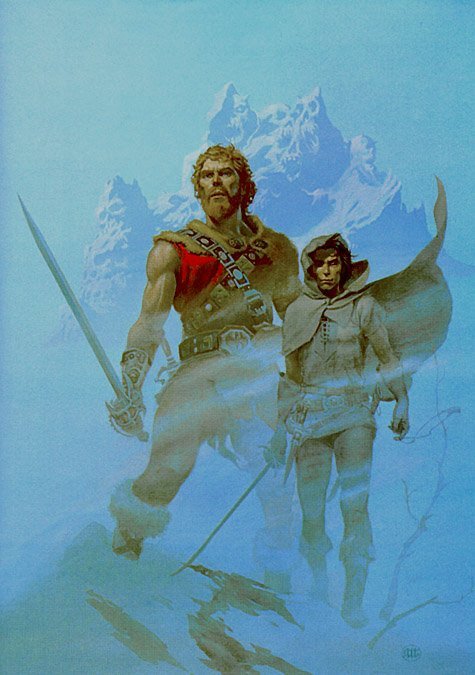
Fafhrd and the Gray Mouser, by Fritz Leiber
First of all, I think it's worth pointing out that I mentioned a specific type of fantasy above: epic fantasy as distinct from sword and sorcery, steampunk and urban fantasy. Sword and sorcery, at least as typified by, for example, Fritz Leiber's Lankhmar stories, is very well-suited to the shorter form, and given how much overlap there is between it and epic fantasy, might present a key argument against my thesis above. In fact, you could even argue that sword and sorcery is epic fantasy specifically adapted for short stories.
But I feel that analogy starts to break down, because of the absolute preponderance of gigantic fantasy novels on bookshelves these days, and the near-total lack of work in that genre in the short form (apart from George RR Martin and Gardner Dozois's recent anthologies). But even urban fantasy seems to be best delivered in the form of series of full novels, though notably shorter than those in epic fantasy. As for steampunk, a genre I haven't read much of, it seems to me that it straddles the line between SF and plain old F - and even there you don't see huge amounts of short story length work.
Economics probably sheds more of a light on this. My understanding is that writing novels pays better than writing short stories - at the very least, GRRM's brick-sized tomes are easier to stock than, say, Daniel Abraham's "The Cambist and Lord Iron", which means they're easier to sell. And yet...
Looking through the listings of speculative fiction magazines, it's clear that science fiction still dominates that scene. And even though he's not a household name like George RR Martin is (at least, in my household), Ted Chiang has still made a name for himself writing almost exclusively in the short story or novelette forms. So there's more to this than the fact that the trend in bookstores now is for ever-bigger novels - and let's be honest, there are few science fiction authors out there, apart from Peter F Hamilton, coming out with series of doorstopper novels.
Maybe you could argue that there's less to explain with more futuristic stories, although I don't think that's necessarily true. Another argument is that science fiction effectively spread into the mass market through short stories published in pulp magazines, although that ignores the work of Robert E Howard or HP Lovecraft, which also came from the pulps.
In any case, this whole line of thinking of mine comes from the whole question of what the best way is to break into the industry. While I subscribe to Steve Martin's advice - "be so good they can't ignore you" - I also wonder sometimes whether I should be focusing on writing and refining my short stories, or on my novels. There are examples of writers who have done both, and in both genres - that Daniel Abraham story I referenced above clearly leans more toward fantasy than science fiction. But it's an interesting question, I thought, and hope I can get someone else's thoughts on it.
Sunday, 14 April 2013
Saga #12: Gay bukkake robot mess blows up in everybody's faces
One of the big stories in the Nerd World this week was the fact that Apple had apparently banned sales of the latest issue of Brian K Vaughan's Saga from its online store, because of panels showing depictions of gay sex. I first saw the story on the AV Club, which also noted that Apple had removed the first issue of Joe Casey's new series Sex the previous month; so, being the inquisitive individual that I am, I went straight to the Forbidden Planet in London to see what the big deal with these comics was.
Verdict? Yep, both pretty explicit.
But on the other hand, on the page opposite one of the offending panels in Saga #12, a character explodes into a bloody mess. This death is particularly horrific, because the character in question appears to be some kind of adorable talking hamster.
I won't be the first person to say it (hell, it was in the AV Club news article), but I continue to be surprised at the double standard regarding depictions of sex versus violence. It isn't just Apple being Apple (and apparently it wasn't rejected by Apple at all, but by Comixology, so go figure), it's something that appears to be endemic in all of American culture. As a general rule, you can sell all kinds of violent content to kids, but the minute you throw full frontal nudity into the mix (because that's really the problem here, as I see it, not the fact that both Sex and Saga are depicting same-sex, er, sex), well, time to call in your First Amendment lawyer.
To be clear, I'm not saying Vaughan and Casey (and their artist collaborators, Fiona Staples and Piotr Kowalski) shouldn't be allowed to depict violence either. Both Sex and Saga are clearly aimed at adult readers, who presumably won't get irredeemably corrupted by glimpses of gay bukkake robot face or girl-on-girl hooker action (this week's post is going to have some fun SEO). What is worrying is that, particularly in the digital world, these adult readers are being told they can't have access to certain content.
The irony is that both of these comics were displayed at eye level for kids at the Forbidden Planet; they also put a disclaimer on the shelf beneath Saga #12 that it's even more "mature readers only" than usual, which is just going to get more people to pick the damn thing up. So we potentially have a situation where consenting adults can't access certain content digitally, but children can grab the physical product off store shelves.
There has to be a better fix for this stuff, frankly. Apple's pretty full of clever people, so I figure they could come up with something that would actually stop kids from accessing objectionable material. But longer-term, American culture needs to sort out this double-standard of sex-bad-but-gruesome-violence-okay.
Anyway, I'll close here with Vaughan's own statement on the kerfuffle, which was released before the word emerged that Saga #12 had been banned by Comixology. He has subsequently apologized, and Comixology is saying the comic will actually be available soon.
Oh, and sorry for the title, but frankly, I couldn't resist.
Verdict? Yep, both pretty explicit.
But on the other hand, on the page opposite one of the offending panels in Saga #12, a character explodes into a bloody mess. This death is particularly horrific, because the character in question appears to be some kind of adorable talking hamster.
I won't be the first person to say it (hell, it was in the AV Club news article), but I continue to be surprised at the double standard regarding depictions of sex versus violence. It isn't just Apple being Apple (and apparently it wasn't rejected by Apple at all, but by Comixology, so go figure), it's something that appears to be endemic in all of American culture. As a general rule, you can sell all kinds of violent content to kids, but the minute you throw full frontal nudity into the mix (because that's really the problem here, as I see it, not the fact that both Sex and Saga are depicting same-sex, er, sex), well, time to call in your First Amendment lawyer.
To be clear, I'm not saying Vaughan and Casey (and their artist collaborators, Fiona Staples and Piotr Kowalski) shouldn't be allowed to depict violence either. Both Sex and Saga are clearly aimed at adult readers, who presumably won't get irredeemably corrupted by glimpses of gay bukkake robot face or girl-on-girl hooker action (this week's post is going to have some fun SEO). What is worrying is that, particularly in the digital world, these adult readers are being told they can't have access to certain content.
The irony is that both of these comics were displayed at eye level for kids at the Forbidden Planet; they also put a disclaimer on the shelf beneath Saga #12 that it's even more "mature readers only" than usual, which is just going to get more people to pick the damn thing up. So we potentially have a situation where consenting adults can't access certain content digitally, but children can grab the physical product off store shelves.
There has to be a better fix for this stuff, frankly. Apple's pretty full of clever people, so I figure they could come up with something that would actually stop kids from accessing objectionable material. But longer-term, American culture needs to sort out this double-standard of sex-bad-but-gruesome-violence-okay.
Anyway, I'll close here with Vaughan's own statement on the kerfuffle, which was released before the word emerged that Saga #12 had been banned by Comixology. He has subsequently apologized, and Comixology is saying the comic will actually be available soon.
Oh, and sorry for the title, but frankly, I couldn't resist.
Subscribe to:
Posts (Atom)